A kayak trolley is a wheeled frame that slides under the hull of your kayak so you can walk the boat from the car to the water. In Ireland it is called a trolley, not a cart. You will hear paddlers call them boat trolleys, kayak carts, and kayak dollies — they all mean the same thing.
A trolley is not optional on most Irish launches. Long sandy strands, grassy lakeshores, and piers with an upper and lower slipway turn a 30-kilogramme sea kayak into a back injury waiting to happen. The right trolley removes that problem in about €100 of kit.
This guide covers what a trolley does, the three main types and four wheel types, twelve named models with prices, how to match capacity to your kayak, how to read Irish launch terrain, how to fit and maintain one, a full DIY build with parts costed at Irish hardware shops, the six most common field failures and how to fix them, what storage habits decide whether a trolley lasts five seasons or fifteen, every retailer that stocks them in Ireland, the second-hand market on DoneDeal and Adverts.ie, and how anchor trolleys are completely different (they are not trolleys at all).
What Is a Kayak Trolley?
A kayak trolley is a wheeled structure that lifts the hull off the ground and lets you roll the boat to the water. Every trolley has three parts — two wheels, a crossbar or axle, and a support system that cradles the kayak. The support is either a shaped cradle, a pair of padded uprights, or a strap that wraps over the hull and clips tight.
You load the kayak onto the trolley on dry ground, wheel it to the water, unclip the trolley, and walk it back to the car. The whole process takes under a minute once you have done it a few times.
Irish launches reward trolley use more than most countries. Slipways at Connemara piers, the long strands of Kerry and Donegal, and grassy access points on Lough Derg all have distances that would ruin your back without wheels.
The Three Main Types
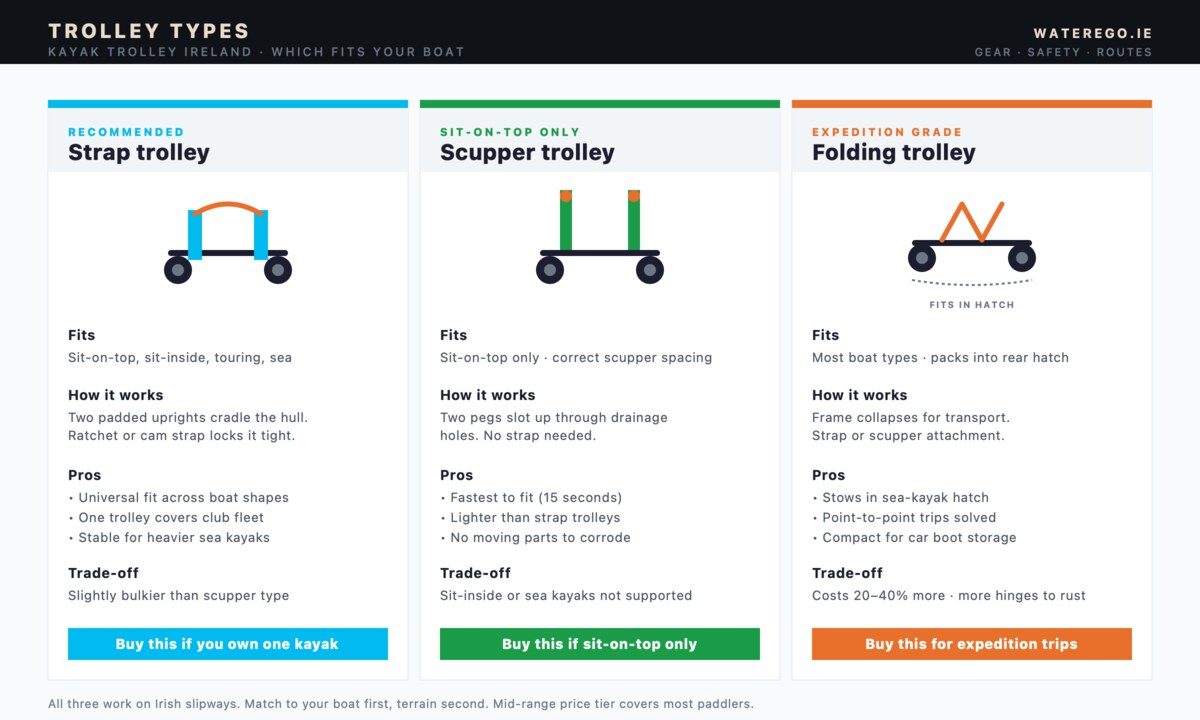
Strap trolley
The strap trolley is the common choice for Ireland. Two padded uprights hold the hull, a ratchet or cam strap wraps over the top, and the kayak sits stable at the centre of balance. It works with almost every kayak shape — sit-on-top, sit-inside, touring, sea. One strap trolley covers a club’s whole fleet.
Scupper trolley
Scupper trolleys have two pegs that slot up through the drainage holes of a sit-on-top kayak. They are fast to fit and carry less weight themselves, but they only work with sit-on-tops that have the right scupper spacing. If you own a sit-inside touring kayak or sea kayak, a scupper trolley is not for you.
Folding trolley
Folding designs collapse into a compact package that fits inside the rear hatch of a sea kayak. Useful for expedition paddlers who launch in one place and take out somewhere else. The trade-off is slightly lower weight capacity and more moving parts to check for corrosion. A good folding trolley costs 20 to 40 percent more than the equivalent non-folding model.
Wheel Type — Why It Decides Everything
The wheel is the single most important component on a kayak trolley. Frame quality matters; padding matters; the strap matters. None of it matters if the wheel is wrong for the surface you launch on. There are four wheel types you will encounter in Irish retailers.
Solid rubber and polyurethane
Hard rubber or solid polyurethane wheels — the standard Railblaza “Kiwi” wheel is the best-known example — are essentially indestructible. Zero punctures, zero air, zero maintenance, no pump kit needed on a remote launch. They roll efficiently on concrete slipways, tarmac, hard-packed gravel, and wet sand. The cost is comfort and softness. Every bump goes straight up through the hull, soft dry sand swallows them because the contact patch is small and rigid, and on shingle they skip rather than roll. Specifically: solid wheels fail on dry dune sand above the high-tide mark, and on long loose-gravel portages where the lack of cushioning fatigues the frame.
Pneumatic standard 25 cm (10 inch)
The default for mid-range Irish trolleys — Palm Caddy, Eckla Atlantic 260, Riber Standard. Air-filled tyres around 25 centimetres in diameter give a soft, low-effort roll on uneven ground and absorb the vibration that would otherwise shake the kayak off the trolley. Run them at 15 to 25 PSI (1.0 to 1.7 bar) for general use. Drop to about 12 PSI on soft surfaces for a bigger contact patch; pump back up to 25 PSI for long tarmac pulls so the sidewalls do not deform. The known failure mode on Irish launches is explosive punctures from gorse, blackthorn, broken oyster shell at low-water slipways, and razor clam fragments on Atlantic strands. Carry a spare tube and a mini pump, or move up to puncture-proof wheels if you launch on overgrown coastal access.
Balloon or sandbow (30 cm and larger)
Very large, very low-pressure polyurethane balloons — Wheeleez 30 centimetre wheels and the Eckla Beach Rolly’s sandbow tyres are the genuine articles — work on a different principle. Instead of trying to roll on top of soft sand they deliberately flatten across it. At 2 to 4 PSI they spread a contact patch the size of a dinner plate and drop ground pressure below the threshold at which dry sand gives way. Same principle as a fat-bike or a beach buggy. The trade is bulk, price (often double a standard trolley), and a tendency to feel vague on tarmac because the sidewall is constantly working. For Atlantic-facing Irish strands — Derrynane, Inch, Banna, Lahinch above the high-tide mark — balloons are the only tyre that genuinely works without a second person carrying the bow.
No-flat polyurethane (the “Tuff-Tire” school)
Closed-cell polyurethane foam wheels — Wheeleez Tuff-Tire, the Galaxy 26 centimetre, Ruk Sport PU, Suspenz DLX airless — split the difference. They give roughly 80 percent of the comfort of a pneumatic at 25 PSI, they cannot puncture, and they need no pump. Real-world from Irish and UK kayak forums: they are heavier than air tyres (noticeable when you lift the loaded trolley over a stile), they harden in cold weather, and the lower-grade polymer wheels on cheap imports can take a permanent flat spot if the trolley is stored for months with a kayak parked on it. Premium versions — the Wheeleez Tuff-Tire and the Railblaza Kiwi wheels — hold their shape indefinitely. For most Irish paddlers who do not routinely launch off soft strand, this is the optimal default.
The shortest possible decision tree: launch on concrete or wet hard sand only — solid is fine; launch on grass, gravel, and mixed terrain — no-flat polyurethane; launch on dry strand or dune-back — balloon. If you do all three, no-flat polyurethane and accept it will be slightly harder work on the strand.
What It Should Cost in Ireland
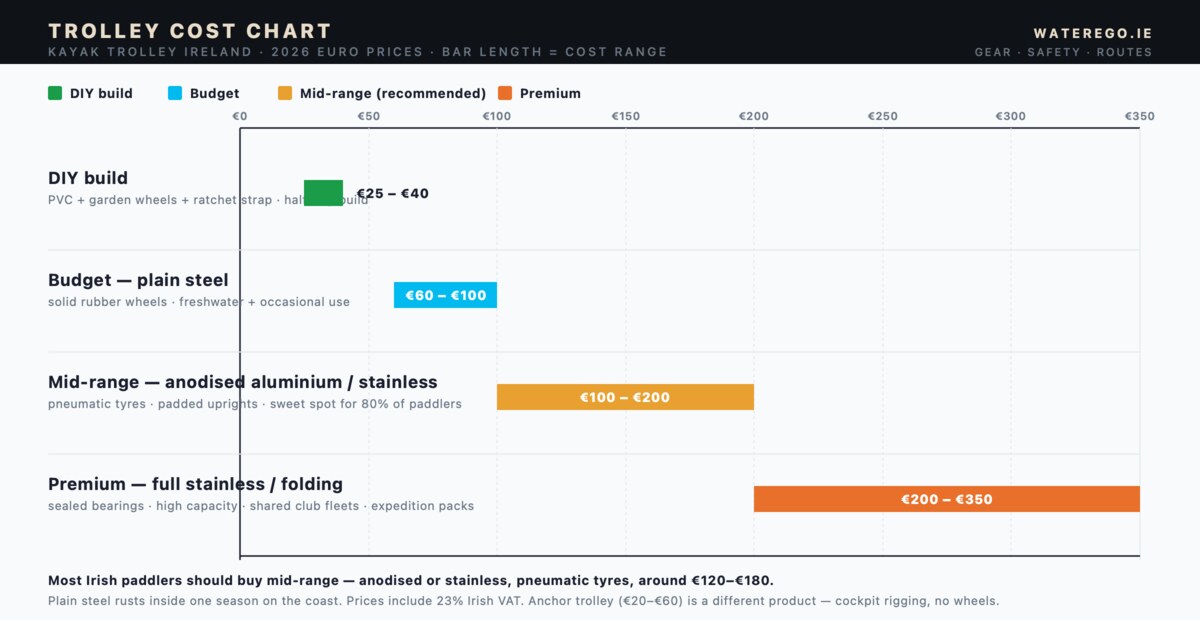
All prices include 23 percent Irish VAT.
| Tier | Price Range | What You Get |
|---|---|---|
| Budget | €60–€100 | Plain steel frame, solid rubber wheels. Fine for freshwater and occasional use. |
| Mid-range | €100–€200 | Anodised aluminium or stainless steel frame, pneumatic tyres, padded uprights. The right choice for 80 percent of Irish paddlers. |
| Premium | €200+ | Full stainless construction, sealed bearings, higher load capacity, folding options. For heavy sea kayaks, frequent coastal use, or shared club fleets. |
A plain steel trolley on a saltwater coast will rust inside a season. The extra €40 to €80 for anodised aluminium or stainless steel pays for itself the first time you avoid replacing the frame.
Specific Model Picks — What to Actually Buy
Twelve named models that cover the realistic use cases. Prices are 2026 EUR including 23 percent Irish VAT, drawn from Irish retailer listings (Canoe Centre, CH Marine, 53 Degrees North, Viking Marine, Atlantic Kayaks NI) and UK distributor pricing where the model is imported. Numbers are typical RRP — the second-hand market and end-of-season sales routinely cut 20 to 40 percent off.
| Model | Use case | Wheel | Frame | Capacity | Folds | RRP € |
|---|---|---|---|---|---|---|
| Riber Standard (Model 4022) | Cheapest entry | Pneumatic 25 cm | Anodised aluminium | 36 kg | Yes | €45–€55 |
| Ruk Sport Rambler | Budget no-flat / club fleet | PU no-flat 20 cm | Aluminium tube | 50 kg | Yes | €65–€75 |
| Palm Caddy | Mid-range strap, fits in day hatch | Pneumatic 26 cm | Marine aluminium | 60 kg | Scissor fold | €115–€135 |
| Palm Big Caddy | Mid-range for bigger boats | Pneumatic 26 cm | Marine aluminium | 80 kg | Scissor fold | €145–€170 |
| Railblaza C-Tug (Kiwi wheels) | Premium all-rounder | Solid Kiwi 24 cm | Engineering plastic + stainless | 120 kg | Tool-free | €140–€160 |
| Railblaza C-Tug SandTrakz | Sandy beach without true balloons | Polymer track 24 cm | C-Tug frame | 120 kg | Yes | €165–€190 |
| Eckla Beach Rolly | Convertible — trolley + deck chair | Pneumatic balloon 26 cm | Rust-proof aluminium | 70 kg | Folds flat | €155–€180 |
| Eckla Atlantic 260 | Dedicated sea kayak | Pneumatic 26 cm | Anodised aluminium, stainless | ~40 kg | Strips to fit through 190 mm hatch | €170–€200 |
| Wheeleez Kayak Cart Beach | True balloon for soft sand | PU balloon 30 cm | Marine aluminium | 80 kg | Scissor fold | €380–€450 |
| Wheeleez Tuff-Tire | No-flat all-rounder | PU foam 26 cm | Marine aluminium | 80 kg | Scissor fold | €260–€310 |
| Suspenz DLX Airless | Pro / tour-leader | Airless 25 cm | 6061-T6 powder-coated | ~68 kg | Folds flat | €200–€240 |
| Galaxy A07b Scupper | Best scupper-post option | Tuff-Tire 26 cm | Anodised aluminium | 75 kg | Yes | €130–€160 |
A few honest notes on the market in 2026. The original Railblaza C-Tug is being run down in favour of the reinforced C-Tug R — both fit Irish use, but if you have the choice, take the R. The Eckla Atlantic 200 (20 centimetre wheels) is being phased out at Irish dealers in favour of the Atlantic 260. Suspenz and Wheeleez TerraTrek do not appear in Irish stock and effectively need to be imported. The “Wheeleez TerraTrek” name surfaces in older blog posts but the current Wheeleez line is the Beach (balloon) and Tuff-Tire (no-flat) only. Crewsaver does not make a kayak trolley — the brand is PFDs and drysuits — so any “Crewsaver trolley” listing is mislabelled stock.
Capacity matching — minimum cap by kayak type
Trolley load capacity is the most under-spec’d number on a kayak gear list. The rule of thumb: take your kayak’s empty hull weight, add your day-kit (PFD, paddle, spray-deck, two litres of water, lunch, drybag, pump, flares — typically 8 to 12 kg), then add 20 percent as a safety margin. The trolley’s rated number must clear that total, not match it.
| Kayak type | Empty (kg) | + kit (kg) | Minimum trolley cap | Realistic picks |
|---|---|---|---|---|
| Recreational sit-on-top | 16–22 | +8–12 | 40 kg | Riber Standard, Ruk Rambler |
| Touring sit-inside | 20–27 | +10–15 | 50 kg | Palm Caddy, Eckla Atlantic 260 |
| Sea kayak (single, day) | 24–32 | +10–15 | 60 kg | Palm Big Caddy, C-Tug, Wheeleez Tuff-Tire |
| Sea kayak (single, expedition) | 24–32 | +25–40 | 80 kg | C-Tug (120 kg margin), Wheeleez Tuff-Tire |
| Sea kayak (double, day) | 38–48 | +15–25 | 80 kg | C-Tug, Big Caddy |
| Sea kayak (double, expedition) | 38–48 | +40–60 | 120 kg | C-Tug standard or twin-trolley setup |
| Whitewater / playboat | 16–22 | +5–8 | 30–40 kg | Most paddlers shoulder-carry these |
| Fishing sit-on-top loaded | 32–40+ | +20–35 (battery, tackle, cooler) | 80–100 kg | C-Tug, Galaxy A07b scupper, Wheeleez Beach |
The fishing sit-on-top row is the most commonly under-spec’d combination in Ireland. A loaded Galaxy Cruz or Feelfree Lure with a battery, cooler, fish-finder, and an anchor easily clears 70 kg total. A 36 kg trolley under that load buckles within a season.
Matching the Trolley to Irish Terrain
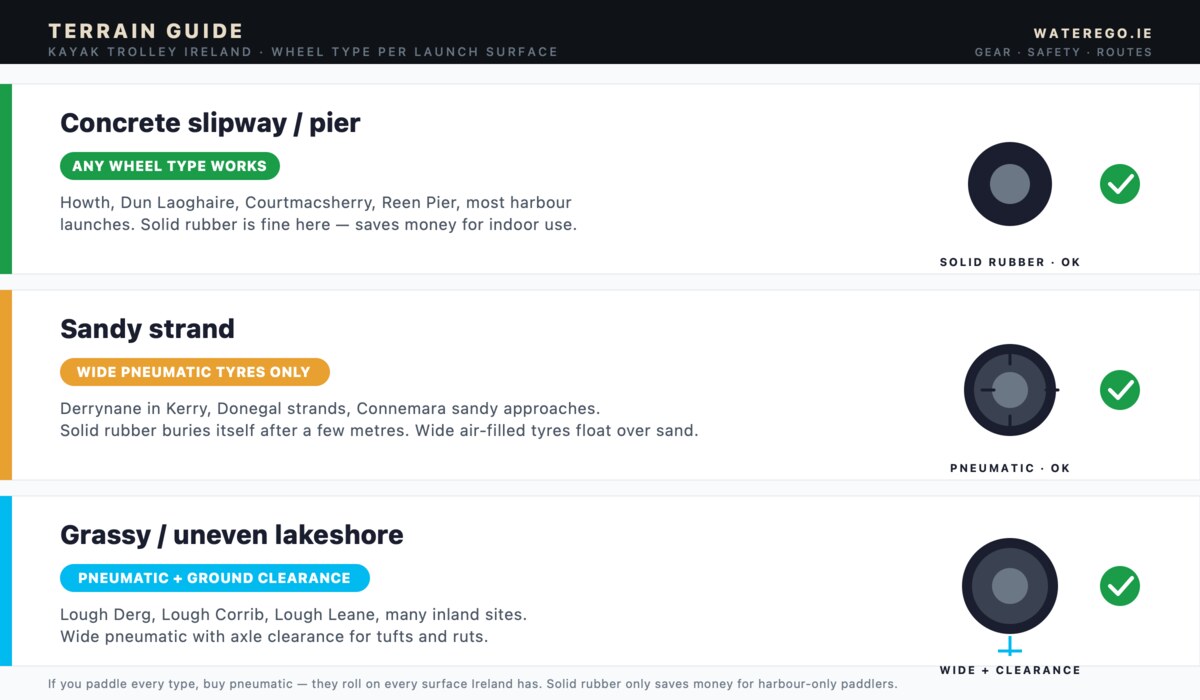
Ireland has three common launch surfaces. The wrong wheels turn a trolley into dead weight.
- Concrete slipway or pier — Howth, Dun Laoghaire, most harbour launches. Any wheel type works. Solid rubber is fine here.
- Sandy strand — Derrynane in Kerry, the strands of Donegal, the long sandy approaches on the Connemara coast. Only wide pneumatic tyres handle sand. Solid rubber wheels bury themselves after a few metres.
- Grassy or uneven lakeshore — launches on Lough Derg, Lough Corrib, and many inland sites. Wide pneumatic tyres again, ideally with some clearance for uneven ground.
If you paddle one type of water, buy for that terrain. If you paddle everything, buy pneumatic. They roll on every surface Ireland has.
How to Fit and Use a Trolley
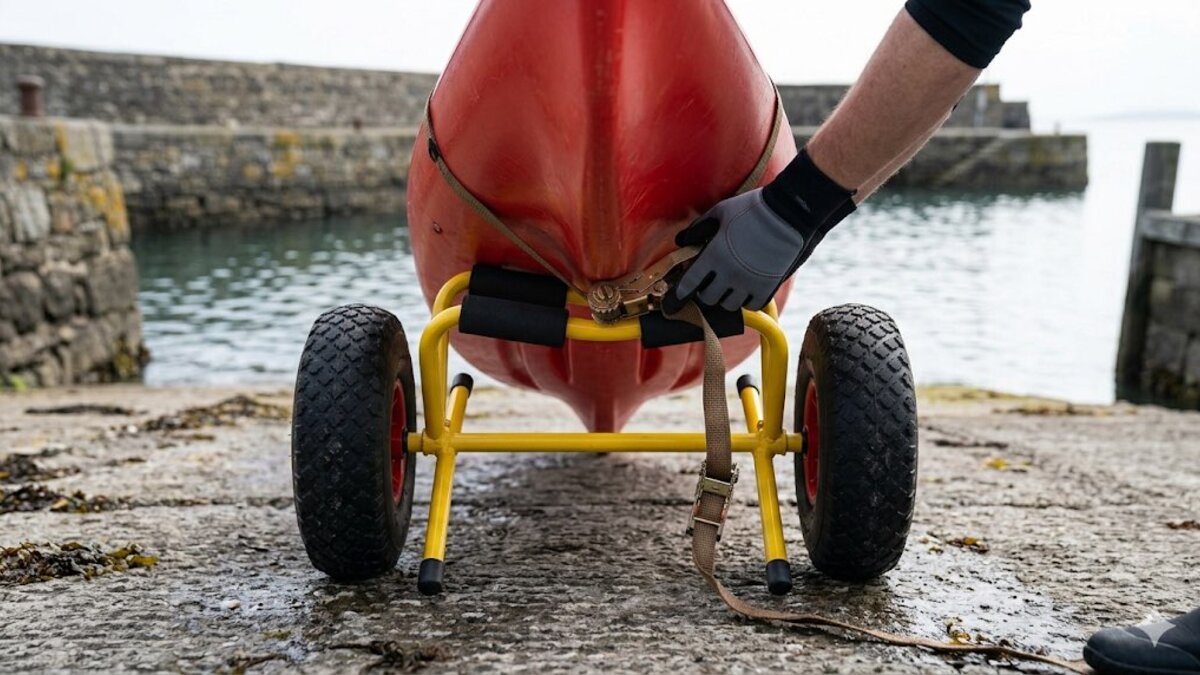
Fitting a strap trolley takes five steps:
- Place the trolley on firm ground, axle first.
- Lift the stern of the kayak and slide the trolley under the hull, roughly one third of the boat’s length forward of the rear.
- Wrap the strap over the top of the hull and feed it through the buckle on the opposite side.
- Pull the strap tight. Rock the kayak side to side — the trolley should not shift.
- Lift the bow with one hand. The trolley carries the stern weight. Walk to the water.
On the way back, lower the bow to the ground before you lift the stern off the trolley. Dropping a composite kayak stern-first cracks hulls. Plastic kayaks are more forgiving but still deserve the gentle treatment.
Maintenance for Irish Conditions
Salt water is the enemy. Every piece of a trolley that touches seawater corrodes unless you wash it off.
- Rinse with fresh water after every sea paddle. Hose it down, spin the wheels, work the strap.
- Air dry before storage. Damp kit rusts. Stand the trolley on its end to drain.
- Store off the ground. A shelf or a wall hook keeps the frame off damp floors.
- Grease the axles every few months. A smear of marine grease on each wheel hub extends bearing life by years.
- Inspect bearings twice a year. Most wheel bearings can be repacked with grease. Sealed bearings need replacing when they fail.
The two-minute rinse after a saltwater paddle is the single habit that decides whether your trolley lasts one season or ten.
The DIY Route — A Full Build in One Saturday Morning
A homemade kayak trolley built from anodised aluminium tube and stainless hardware will carry an 80-kilogramme load, last ten seasons of Atlantic salt, and cost around €141 in parts from Irish shops. Half a day with a hacksaw, a drill, and a vise. The trade-off versus a commercial trolley is mainly the lack of an independent load test — what you build is on you.
Parts list — Irish sourcing, 2026 prices (incl. 23 percent VAT)
| Part | Spec | Source | Price |
|---|---|---|---|
| 2× pneumatic wheels | 260 mm (10″), 20 mm bore, 150 kg rated, roller bearing | Woodie’s | €27.99 each |
| Axle rod | M12 stainless steel (A2) threaded bar, 1 m, cut to ~650 mm | Toolstation / Screwfix Ireland | €14.50 |
| Frame tubing | Anodised aluminium round tube, 25 mm OD × 1 m × 2 mm wall (need ~2 m total) | Lenehans.ie / Screwfix Ireland (Rothley range) | €16.99 each |
| Cradle padding | Closed-cell foam pipe insulation 22 mm bore × 1 m + pool noodle backup | Woodie’s plumbing aisle | €6.50 |
| Strap + buckle | Lashing strap with cam buckle, 25 mm × 3 m (Suki or Tactix) | Woodie’s | €9.99 |
| End caps + retaining clips | 25 mm round push-fit end caps (×4) + zinc R-clips 3 mm (×4 pack) | Screwfix Ireland | €8.50 |
| Misc | M12 stainless washers (×6), M12 stainless nyloc nuts (×4), tube clamps, self-tappers | Screwfix Ireland | €12.00 |
| Total | €141.45 |
If your kayak is over 25 kilogrammes dry, step the frame up to 32 mm OD aluminium tube (~€22 per metre). The €15 frame stiffness gain is worth more than any other single upgrade.
Step-by-step build
- Sketch and cut. Decide your axle length — kayak beam at the cradle point, plus 250 mm clear each side for the wheels (typically 600 to 700 mm). Mark the aluminium for two 450 mm uprights and one 350 mm cross-piece. Cut with a hacksaw or mitre saw using a sacrificial timber block in the vise to stop the tube crushing.
- Deburr every cut. Aluminium swarf is razor-sharp and will slice through strap webbing on the first outing. Half-round file inside and outside, then 240-grit emery cloth. Safety glasses on — anodised flakes fly.
- Drill the axle holes. Mark the centre of each upright 30 mm from the bottom end. Clamp horizontally in the vise (timber pads). Pilot at 4 mm, step up to 13 mm. Cutting oil, slow speed — aluminium grabs the bit.
- Drill the R-clip holes in the axle. Mark 15 mm from each end of the 650 mm M12 bar and again 15 mm inboard of each wheel hub. Drill 3.5 mm through. Cutting fluid is mandatory on stainless — without it you work-harden the spot and snap drill bits.
- Build the cradle cross-piece. Cut the 350 mm aluminium cross-tube. Drill paired holes through cross-tube and uprights at the chosen cradle height (typically 200 mm above the axle). Join with stainless M6 bolts and nyloc nuts — no glue, no rivets, so you can rebuild it later.
- Bend or angle the cradle arms. A straight cross-tube with padding works for sit-on-tops. For a V-cradle that hugs hard-chined sea kayaks, cut the cross-piece into two 175 mm halves and bolt them to the uprights at about 30 degrees.
- Pad the cradle. Slit the foam pipe insulation lengthways with a Stanley knife, slide it over the cradle arms, zip-tie each end. Trim the tie tails flush so they cannot abrade the hull.
- Fit end caps to the upright tops. Push-fit caps stop rainwater entering the tube (it freezes, splits aluminium over a winter) and round off the upright so the trolley does not snag clothing during loading.
- Mount the wheels. Slide on one washer, then a wheel, then another washer. Push the axle through the first upright, repeat on the other side, secure with R-clips through the inboard and outboard holes. Spin each wheel — it should turn freely with no axial slop.
- Add the strap mounts. Drill 8 mm holes through the cradle uprights at the cross-piece, thread the lashing strap through, tie a stopper knot inside. The cam buckle lives on the loose end for tightening over the hull.
- Test load. Place the cradle just aft of the cockpit on a sea kayak (or just aft of centre on a sit-on-top). Strap snug, lift the bow, walk ten metres on tarmac. Watch for upright flex, axle deflection, or strap slip.
- Salt-water dunk test. Wheel it through 30 centimetres of seawater, lift out, leave overnight. Next morning check for galvanic corrosion at any non-stainless junction. White powder means that fastener needs swapping before the trolley sees a real launch.
The drill is the most likely thing to bite you on this build — never hold tube in one hand and drill with the other. Clamp every cut, every drill.
Three DIY upgrades worth doing
- Full stainless hardware swap. Any zinc-plated bolt, nut, washer or R-clip on a coastal trolley loses its plating in about six weeks of saltwater use. Swap to A2 marine-grade stainless before the first real launch. Priority: the axle (already stainless above), M6 cradle bolts, all wheel-hub washers, R-clips. €8 at Screwfix Ireland. The galvanic couple between stainless and aluminium is mild but a smear of Tef-Gel or Duralac on the threads is belt and braces.
- Balloon tyres for sand. The 260 mm pneumatic is excellent on gravel and concrete but sinks in dry sand and shell beach. Wheeleez balloon wheels (300 mm or 420 mm) are the gold standard — sold through Ross Castors UK and shipped to Ireland. Cheaper option: a 13-inch TPU balloon set from Amazon UK (VEVOR or SKYSHALO branding) at around €60 a pair delivered. The Wheeleez hub is 20 mm bore so the M12 axle needs a 12-to-20 mm nylon sleeve — either turn one yourself or buy a 20 mm aluminium spacer. Do not run balloon tyres on tarmac. The soft TPU compound wears through in a few outings.
- Padded yoke from pipe insulation. The basic foam-tube cradle works fine for short launches. On a long portage of 200 metres or more the kayak hull starts to feel the cradle’s flat profile. Slice a second layer of 28 mm bore pipe insulation and bond it over the first with contact adhesive — gives a double-density, semi-V profile that spreads load across more of the hull. Total cost €4, total weight gain about 80 grammes.
Three DIY mistakes that ruin the build
- Frame too narrow — the kayak tips on the smallest camber. Reported on every Irish and UK paddling forum: builders copy a photo without measuring their own kayak, end up with cradle uprights 350 mm apart on a 600 mm-beam sea kayak, and the boat rocks every time a wheel meets a kerb. The rule: outer wheel-to-wheel width must be at least 1.3× your hull’s maximum beam at the cradle point.
- PVC frame instead of aluminium — fine on tarmac, snaps on the rough. The cheap-build internet tutorial uses 32 mm PVC pressure pipe. Every long-running kayak forum documents the same failure mode: a root, a kerb edge, or a hard drop onto a slipway, and the PVC at the T-junction shears with no warning. Aluminium bends visibly first — that warning is the build’s safety margin.
- Undersized axle that bends under load. Budget carts and DIY builds running 10 mm mild steel axles bend within a season. For anything over 25 kilogrammes loaded, use M12 stainless minimum. For expedition-loaded touring kayaks (40 kg+), step up to M14 or a solid 12 mm 316 stainless bar with welded shoulders. One Irish builder went through three axles before stepping up gauge.
The honest assessment: for a 15-kilogramme recreational kayak used on a calm lake in summer, the basic DIY build is fine. For a 30-kilogramme sea kayak loaded with camping gear on an exposed Atlantic coast, this build with the stainless upgrades will handle it. For anything heavier — a fully loaded fishing sit-on-top or expedition double — buy commercial and accept the cost.
Kayak Anchor Trolley — A Completely Different Thing
An anchor trolley is not a transport trolley. The name is misleading.
An anchor trolley is a pulley-and-line system you install along the deck of a fishing or sit-on-top kayak. It lets you reposition your anchor point from bow to stern without leaving your seat — critical when an anchored kayak starts swinging in current. No wheels, no walking, no kayak transport. Pure cockpit rigging. Expect to pay €20 to €60 for the pulleys, line, and clam cleats.
If you searched for a kayak trolley and this is what you actually need, the two products have nothing in common except the word “trolley.”
Common Failures and Field Repair
Six failures account for almost every dead trolley on Irish slipways. Each has a known prevention, and each has a three-minute field fix that gets you back to the car.
1. Tube puncture from shell, oyster bed, or thorn
What fails: the inner tube of a 25 to 26 centimetre pneumatic, often with an explosive sidewall failure that takes the tyre with it. Why it fails: razor-clam shell, oyster cluster, broken glass at urban slipways, blackthorn on overgrown coastal access. Pneumatics are designed for wheelbarrows, not Irish substrate. Prevention: run tubeless or solid-foam wheels for any launch more than 50 metres from the car; inflate pneumatics to the upper end of their rated pressure (around 30 PSI / 2.0 bar) so the tyre rolls over shell rather than wrapping around it. The three-minute fix: pull the R-clip, slide the wheel off, deflate fully, peel one bead off the rim with a spoon-handle, find the hole with saliva (it bubbles), patch with a glue patch from the kit, reseat, reinflate with the mini-pump. If the sidewall has gone, stuff the tyre with dry beachgrass or a rolled-up dry-bag and walk it back at half-pace.
2. Strap fray and ratchet jam from salt
What fails: the polyester webbing fluffs at the cam buckle exit; ratchet pawls seize under a white salt crust; the strap stops biting. Why it fails: salt crystals work into the weave and act as abrasive every time the strap is tensioned. Ratchets with steel internals are worse than cam buckles for salt jam. Prevention: use cam buckles, not ratchets; rinse with fresh water after every salt launch; cut frayed ends and heat-seal with a lighter. The three-minute fix: soak the buckle in your drinking water for 30 seconds, work the pawl back and forth, then dose with the multi-tool’s pivot oil (or in a pinch, a smear of sunblock — zinc oxide is a temporary lubricant). For a frayed strap, fold it back on itself through the buckle so a fresh section bears the load.
3. Bearing seizure from sand intrusion
What fails: the cheap nylon-bush bearing in budget pneumatics grinds, then locks. With roller bearings, sand defeats the dust seal and pits the races. Why it fails: wading the trolley through surf or dragging it across wet sand pumps fines into the bearing every revolution. Prevention: never push a loaded trolley into water deeper than the hub centre; pop the wheels off and carry them through the surf zone; repack roller bearings annually with marine grease. The three-minute fix: pull the R-clip, slide the wheel off, hold the bearing under a steady pour of fresh water from your drinking bottle to flush the sand, dry with the corner of a drybag, smear marine grease (carry a 10 g sachet) onto the race, refit. It will not last forever but it gets you home.
4. Bent axle from overload
What fails: the axle takes a permanent bow, wheels splay outwards (positive camber), the trolley crab-walks. Why it fails: loading a kayak full of camping gear (commonly 50 kg or more) onto a trolley rated for 45 kg, then dropping the bow onto the cradle from height. Prevention: know your trolley’s rated load and clear it by 20 percent; lower the kayak onto the cradle gently. The three-minute fix: true field-straightening is wishful thinking. The realistic patch is to pull both wheels, lay the axle on two rocks spaced about 400 mm apart with the bow upwards, and step gently on the apex until it is visually straight. Better: carry a spare 650 mm length of M12 stainless threaded bar (about 120 g) on multi-day trips.
5. Cracked plastic cradle from UV exposure
What fails: polypropylene cradle pads and frame joiners go chalky, then split along moulding lines after two or three summers stored outdoors. Why it fails: UV breaks the polymer chains in polyethylene and polypropylene — the same process that fades a kayak hull, only worse on a trolley because cradle plastic is rarely UV-stabilised. Prevention: store indoors or under a tarp; apply 303 Aerospace Protectant or equivalent twice a year; replace with aluminium cradle arms if you have already cracked one. The three-minute fix: tape the crack with self-amalgamating silicone tape from the kit — it bonds to itself, not the plastic, so it survives wet. If the cradle has separated completely, lash the kayak directly to the bare frame uprights with the spare paracord, padding the contact point with a buoyancy aid or cag.
6. Lost retaining R-clip from vibration
What fails: the 3 mm zinc R-clip walks out under road or slipway vibration; the wheel slides off mid-portage. Why it fails: zinc R-clips lose spring tension in salt; the legs splay slightly each time the wheel is removed. Prevention: stainless R-clips, two spares carried (they weigh nothing), or stainless lynch pins for any axle you remove regularly. The three-minute fix: spare R-clip from the kit, 5 seconds. With no spare — a stainless split-ring from a fishing tackle box, a bent paperclip, or doubled stainless wire through the axle hole will all get the wheel home. Clamp the ends so they cannot unwind.
Field-repair kit — under 200 grammes, fits in the day hatch
A flat zip pouch stowed against the hatch wall:
- Bicycle puncture patch kit (Rema TipTop TT02 or Park Tool VP-1) — six patches, glue, sandpaper. About 30 g.
- Mini pump or two CO2 cartridges — Lezyne Pocket Drive or 2× 16 g threaded CO2 with adaptor. 50 to 80 g.
- Mini multi-tool — Leatherman Squirt PS4 or similar with pliers, screwdriver, knife in 56 g.
- Six cable ties (200 mm × 4.8 mm, stainless or UV-stable black nylon) — about 6 g.
- Two spare stainless R-clips (3 mm) — 2 g.
- One metre of self-amalgamating silicone tape — for strap whip, cradle cracks, even hull pinholes. 10 g.
- 10 g sachet of marine grease in a snap-lid 35 mm film canister. 12 g.
- Two metres of 2 mm Dyneema cord or paracord — strap replacement, lashing, throw-line. 10 g.
- Tube of Aquaseal UV or one Gator Patch — doubles for trolley cradle and hull repair. 25 g.
Add a spare 200 mm of M12 stainless threaded bar plus two nuts (120 g) for multi-day trips. Pack weight without the spare axle: roughly 165 grammes.
Storage and Off-Season Care
How a trolley spends six winter months matters more for its lifespan than how it spends six summer months. Five rules cover almost every failure mode that shows up at the first April launch.
- Store vertical, wheels up. Hang from a wall hook through the cradle. Horizontal storage with weight on the tyres develops sidewall flat-spotting and concentrates load on a single set of bearing rollers. Vertical also keeps any residual moisture draining out of the aluminium tubing.
- Half-pressure on pneumatic tyres. About 15 PSI (1.0 bar) for a 25 to 26 centimetre wheel. Fully deflated tyres collapse and crack the sidewall at the bead; fully inflated tyres stress the casing over a cold winter. Half-pressure is the consensus from bike-storage and cart-storage practice.
- Straps clean, dry, rolled — not flat-folded. Wet straps grow mildew in a week and the buckle corrodes. Soak in lukewarm fresh water with a teaspoon of mild detergent, dry fully on a radiator (not direct heat), then roll loosely into a cotton bag. Flat-folding creates permanent creases that become abrasion points.
- Bearing service cycle. Occasional paddler (under 20 launches a year) — clean and re-grease once at season-end. Frequent paddler (40+ launches, mixed terrain) — clean and re-grease mid-season and again at season-end; replace cartridge bearings every second year regardless of feel.
- Pre-season inspection — eight items, in order. Spin each wheel and listen for grit; check tyre pressure and sidewall condition; confirm R-clips are present with legs fully closed; sight along the axle thread for corrosion at the nuts and for straightness; check cradle padding for UV chalking; full-length tug test on the strap webbing; re-torque any M6 cradle bolts that have backed off; sweep the frame for white powder at any junction of dissimilar metals and clean with a wire brush before the first salt launch.
The single habit that decides whether your trolley lasts five seasons or ten is the two-minute fresh-water rinse after every saltwater paddle. Everything in this section reinforces that one habit.
Common Mistakes Irish Paddlers Make
- Buying a plain steel trolley for coastal use and watching it rust inside one season
- Using a scupper trolley on a sit-inside kayak it was never designed to fit
- Positioning the trolley too far back on the hull, so the kayak pivots and tips
- Forgetting to rinse after a saltwater paddle
- Underestimating combined weight — trolley capacity must cover kayak plus full day kit plus paddle
- Assuming solid rubber wheels will work on Irish sand (they will not)
- Wheeling a loaded kayak over sharp pebbles or oyster beds without checking tyre pressure
Every one of these is avoidable. The most expensive mistake is buying twice because you bought cheap first.
Check Clean Dry — Your Trolley Counts Too
Irish waterways are under pressure from invasive species. Zebra mussels, curly-leaf pondweed, and killer shrimp all hitch rides between waterways — and they hitch on trolley wheels, straps, and frames every bit as much as on kayaks and PFDs.
After every paddle, especially if you move between different waters in one week:
- Check wheels, strap, and frame for any organic matter — weeds, mud, snails
- Clean everything with hot water above 45°C or a dilute disinfectant solution
- Dry fully for at least 48 hours before rolling into a different waterway
The Irish government’s Invasive Species Ireland campaign provides full guidance. Clubs check this at every launch. Solo paddlers need to self-police — including for their trolley.
Cross-Border Buying and Travel
Republic of Ireland VAT is 23 percent. UK VAT is 20 percent. For a €200 trolley the difference is around €6 — rarely worth the shipping and paperwork. For premium purchases over €500, cross-border price comparison is worth the effort.
Irish ferries treat kayak trolleys as part of paddling kit rather than separate luggage. Folding trolleys that pack into a hatch travel without anyone noticing. Larger non-folding trolleys occasionally get a raised eyebrow at check-in — carry it in the car with the kayak and it is a non-issue.
Some National Parks and Wildlife Service protected dune systems restrict wheeled access to prevent erosion. Check local signage before launching on protected coastline.
Where to Buy in Ireland — Verified Retailers
Twelve retailers across the Republic and Northern Ireland actively stocking kayak trolleys as of June 2026. Pricing is the current online price including VAT (23 percent ROI, 20 percent NI). For NI shops, the GBP price is given with an approximate EUR conversion in brackets.
Specialist paddlesport retailers
| Retailer | Location | Brands | Price band | Ships nationwide |
|---|---|---|---|---|
| Canoe Centre | Palmerstown, Dublin | Palm, Eckla (Ecklatop, Pacific, Canyon, Explorer, Atlantic), RTM, Sea Flow | €43–€226 | Yes — free over €75 |
| I-CANOE | Lucan, Co. Dublin | Palm Caddy, Palm Big Caddy, Eckla Orcka-Alaska, Eckla Top 260, NRS Yak Yak, RUK Sport Trident and Rambler, RTM | €65–€129 | Yes — next-day |
| CH Marine | Skibbereen, Cork City, Newtownards, Newry, Kilkeel | Palm, RUK, NRS Yak Yak, Railblaza C-Tug, Railblaza C-Tug Sandtrakz, Sowester | €65–€208 | Yes — free over €80 |
| O’Kayak | Online (Ireland) | Sea Flow Designs Track One Ultra-Light | €95 | Yes — €10 tracked, free over €150 |
| Ishka Watersports | Rathnew, Co. Wicklow | Ishka aluminium trolley (single + tandem) | €75 | Yes — free nationwide |
General outdoor retailers
| Retailer | Location | Brands | Price band | Ships nationwide |
|---|---|---|---|---|
| 53 Degrees North | Carrickmines, Blanchardstown, Cork | Palm Big Caddy | €125 | Yes — free over €100 (ROI + NI) |
| Great Outdoors | Chatham Street, Dublin 2 | Palm and Bulldog accessories range | Variable — phone for current stock | Yes — DPD next-day, free over €75 |
| Decathlon Ireland | Ballymun, Dublin + online | Itiwit / Surf System ultra-compact trolley | Sub-€60 in store typically | Yes |
| Viking Marine | The Pavilion, Dun Laoghaire | Lindemann trolley, generic aluminium cart | €104.95 (Lindemann) | Yes — free over €80 |
| Wildhunter | Dublin (online + showroom) | Wildhunter generic kayak trolley | €69.99 | Yes — free over €199 |
| O’Sullivans Marine | Tralee, Co. Kerry | Cool Kayak foldable Type C, racks and trolleys | €203.90 (Cool Kayak foldable) | Yes — free over €90 |
Northern Ireland
| Retailer | Location | Brands | Price band (£ / approx €) | Ships nationwide |
|---|---|---|---|---|
| Atlantic Kayaks & Leisure | Coleraine, Castlerock | Atlantic Sit-On-Top trolley, Beach Buddy cart, Canoe trolley with straps | £45–£99 (≈ €53–€117) | UK + Ireland, free over £75 |
| CH Marine (NI) | Newtownards, Newry, Kilkeel | Same range as ROI | £55–£175 (≈ €65–€208) | Yes — free over €80 |
| Eglinton Kayaks | Eglinton, Co. Londonderry | Transport accessories category — phone for stock | Not listed online | NI + ROI |
Notable stock patterns
- Railblaza C-Tug dominates the premium end. The single most widely stocked branded trolley on the island. CH Marine carries it across all five branches; second-hand C-Tug listings appear most weeks on Adverts.ie. The SandTrakz wheels variant is specifically stocked by CH Marine and historically by Bantry Bay Canoes for soft-strand use.
- Palm Caddy / Big Caddy is the default mid-range. Every dedicated paddlesport specialist carries one or both in a tight €94–€129 band, making it the easiest model to price-compare across Irish retailers.
- Sub-€80 aluminium trolleys at the generalists. Wildhunter, Ishka, and Decathlon’s Itiwit range fill the entry tier; folding and sea-kayak-specific trolleys are only found at dedicated paddlesport or marine retailers. Suspenz, Harmony, Wheeleez, and Tyx do not appear in Irish-domiciled stock — paddlers wanting those import from UK distributors.
The Second-Hand Market in Ireland
A used trolley is often the best value purchase in the entire kayak fit-out. Trolleys do not have the soft-life rot problem of PFDs or the UV-degraded shell of a kayak hull. A two-year-old C-Tug from a careful owner has another decade in it for €50 to €90.
Where Irish paddlers actually sell trolleys
| Source | Typical used price | What’s on it |
|---|---|---|
| DoneDeal | €50–€275 | The biggest pool — typically 20+ live ads any week. Recent listings: Mayo €69, Cork €50–€60, Galway €155, Tipperary heavy-duty €150–€275. |
| Adverts.ie | €50–€100 typical, premium up to €550 | Often the cleanest listings with full spec. Recent: Kinsale €50, Dunmanway €60, Mullingar Sandtrakz C-Tug €90, Longford €99, Dublin €80–€100. |
| Facebook Marketplace (Dublin + Belfast) | €40–€120 / £40–£100 | Trolleys often listed with the kayak rather than separately — search “kayak wheels” as well as “kayak trolley”. |
| Gumtree NI | £30–£90 (≈ €35–€105) | Best source for NI-side used C-Tug units. Frequently bundled with kayak sales. |
| For-Sale.ie | €50–€150 | Aggregator pulling from DoneDeal and Adverts.ie. About 58 used listings indexed at the time of checking. |
| Club noticeboards | €40–€100 | Posts irregular but reliable — sellers are paddlers, gear well-maintained. C-Tug most common. See the WaterEgo kayaking clubs directory for your nearest club. |
What to inspect before handing over cash
Five-point used-trolley check, takes two minutes:
- Spin each wheel. Listen for grit, feel for axial wobble. A grinding bearing is fixable but factor €15 into the offer.
- Sight the axle. A bent axle is a deal-killer at any price. Look along the bar — even a 2 mm bow over 600 mm shows up clearly. A straight axle reads as a single line.
- Strap test. Full-length tug under body weight. Fluff at the cam buckle exit means the strap needs replacing (€10 from Woodie’s).
- Cradle padding. White chalk that wipes off as powder means UV-degraded plastic. Replaceable but a sign of years of outdoor storage.
- Galvanic corrosion. Any white powder at junctions of dissimilar metals (aluminium to steel) means at least one fastener needs swapping. Walk away or knock €20 off.
Pay by cash on collection and check the trolley in person before money changes hands. A Railblaza C-Tug at €50 is the standard “too good to be true” listing — sometimes it is genuine (downsizing, emigrating, gear-cull), sometimes it is bait. Trust your two-minute inspection.
Consumer Rights and Warranty
Under the Irish Consumer Rights Act 2022, you are entitled to a remedy — repair, replacement, or refund — if a product proves faulty or not fit for purpose. Manufacturer warranties typically run 12 months from purchase, with premium brands extending to two or three years. Irish retailers are obliged to honour the statutory right regardless of manufacturer warranty length.
Keep your purchase receipt. Register the product with the manufacturer if they offer it — some warranties only activate on registration.
Frequently Asked Questions
Do I need a kayak trolley in Ireland?
You need one the moment you paddle anywhere with more than 20 metres between your car and the water. On piers with a concrete slipway you can sometimes carry a kayak solo; on strands, grassy lakeshores, or any launch with soft ground, a trolley is the difference between paddling and not paddling.
Can one trolley fit different kayaks?
A good strap trolley fits sit-on-tops, sit-inside touring kayaks, and most sea kayaks. Scupper trolleys are specific to sit-on-top scupper hole spacing and do not cross over. If you own one kayak, match the trolley to it; if you run a household fleet, buy a strap trolley.
Are club-owned trolleys available for beginners?
Most Irish kayak clubs keep a shared trolley or two for members. Borrowing one at club paddles is normal. Ask your club secretary or look in our club and instructor directory for contact details.
Will my insurance cover trolley damage or theft?
Home contents insurance usually covers kayak trolleys away from the home, but excludes damage from “lack of reasonable care” — which includes corrosion from not rinsing. Dedicated kayak insurance policies handle trolleys explicitly. Read the policy before you assume you are covered.
Can I wheel a kayak through a National Park?
Usually yes on established paths, always no across protected dunes or sensitive grassland. Signage at trailheads is the authority. When in doubt, ask a ranger — most Irish park staff will tell you the quickest legal launch option.
Do ferries accept kayak trolleys as luggage?
Irish ferries carry trolleys with the kayak at no extra charge. Folding trolleys can travel inside the kayak hatch; full-size trolleys typically ride with the boat on the car roof or in the car boot. No Irish ferry operator publishes a trolley-specific policy, which in practice means no one checks.
What is the best kayak trolley for sandy beaches in Ireland?
For deep dry sand above the high-tide mark on Atlantic strands — Derrynane, Inch, Lahinch, Donegal’s strands — a balloon-tyre trolley with 30 centimetre or larger low-pressure wheels is the only design that genuinely rolls without burying. The Wheeleez Kayak Cart Beach (€380–€450) is the gold standard; the Eckla Beach Rolly with sandbow tyres (€155–€180) is the lower-cost balloon. The Railblaza C-Tug Sandtrakz (€165–€190) uses flexible track-style wheels that spread load on soft sand without true balloons — a strong second-best at a much lower price.
Can I take a kayak trolley on Irish public transport or Dublin Bus?
In practice, yes — folding trolleys travel as a folded bundle and rarely attract attention. Larger non-folding trolleys are a grey area. Bus Éireann and Dublin Bus both ban “large items that obstruct the aisle” but apply the rule at driver discretion. Iarnród Éireann (Irish Rail) allows large sports kit including bicycles in the guard’s van on most routes but kayak trolleys are not explicitly listed. The practical answer: a folded trolley (Palm Caddy, C-Tug, Eckla Beach Rolly folded) almost always passes without comment; an assembled trolley does not.
What kayak trolley fits in a sea kayak hatch?
Three models fit the standard sea kayak day hatch (typically 190 mm diameter or larger): the Palm Caddy (folds to 62 × 27 × 7 centimetres), the Eckla Atlantic 260 (strips down to fit through a 190 mm hatch), and the Railblaza C-Tug (tool-free strip-down to a flat package). The Wheeleez balloon-tyre carts and the Eckla Beach Rolly do not fit through a standard day hatch even folded — they typically need to live in the cockpit or on the back deck for expedition use.
How long should a kayak trolley last?
A mid-range anodised aluminium or stainless trolley used on freshwater only and stored indoors will last fifteen years. The same trolley used in saltwater without after-paddle rinsing fails in two to three seasons — corroded fasteners, seized bearings, frayed strap. The single rinse habit doubles or triples expected lifespan. Premium plastic-bodied trolleys (C-Tug, Suspenz airless) do not corrode at all and routinely last twenty years with bearing service every few years. Budget plain-steel trolleys fail in one season on the coast and last about five years inland.
Which Trolley Should You Actually Buy?
Most Irish paddlers are well served by a mid-range strap trolley with pneumatic tyres and an anodised aluminium or stainless steel frame, somewhere in the €100 to €180 range. That kit handles every Irish launch surface, survives saltwater with basic rinsing, and fits whichever kayak you eventually end up with.
Only go premium (€200+) if you are running a shared club trolley, regularly moving a fully loaded expedition sea kayak, or need a folding design for multi-day self-supported trips.
Skip the budget plain-steel trolleys unless you paddle freshwater only and keep the trolley indoors between uses.
Also Read
- Kayaking for Beginners Ireland — Your First Paddle Guide — full first-paddle guide, the partner article for new paddlers buying their first trolley.
- Kayaking Clubs in Ireland — 45 Verified Clubs by County — most Irish clubs share trolleys with members; find your nearest.
- Kayak Rental Ireland — 54 Verified Operators — every operator listed includes a trolley as standard kit. Rent before you buy.
- Blueways Ireland — Every Paddling Trail Mapped — the eight designated flat-water trails where most paddlers first launch a wheeled kayak.
- Sea Kayaking Ireland — The Complete Paddler’s Guide — if you are kitting out for sea kayaking, this comes first.
- Kayaking West Cork — Complete Paddler’s Guide — the densest network of trolley-friendly slipways and strands in Ireland.
- Kayaking Gear Reviews — Community Reviews from Irish Paddlers — real reviews of the kit Irish kayakers actually use.
- Find a Kayaking Club or Certified Instructor Near You — most clubs share trolleys with members.
- Interactive Map of Every Paddling Route in Ireland — check launch surfaces before you choose a trolley.

No comments yet on this route.
Be the first to share your experience — conditions, access, hazards, or anything a future paddler should know.
Login to join the discussion