Ireland has more than 3,100 kilometres of coastline. Most of it is paddleable. From the sheltered bays of West Cork to the exposed headlands of Donegal, sea kayaking in Ireland gives you access to sea caves, offshore islands, and wildlife you cannot see any other way.
This guide covers what sea kayaking is, whether it is safe on Irish waters, how to read the forecast, where to paddle, how to paddle, what to wear, what rescue looks like, and how to learn. It is written for real paddlers. Not tour brochures.
What Is Sea Kayaking?
Sea kayaking — also called coastal kayaking or ocean kayaking — is paddling a long, narrow kayak on open water. That means bays, estuaries, and the open sea. The boat is designed to track straight in wind and waves. It has bulkheads fore and aft that seal off watertight compartments, a spray deck that keeps water out of the cockpit, and deck lines to help in a rescue.
Sea kayaks are not the sit-on-top hire kayaks you see on calm lakes in summer. A proper sea kayak is 4.5 to 5.5 metres long, tracks through chop, handles swell, and carries enough gear for a multi-day trip.
In Ireland, sea kayaking covers three kinds of outings:
- Sheltered bay paddles. Slow pace, calm water, suitable for beginners. Think Kenmare Bay or Glengarriff.
- Coastal touring. Following a coastline on a settled day, ducking into sea caves and island-hopping. Most Irish club paddles sit here.
- Open-water crossings and expeditions. Exposed, committed, only for qualified paddlers. The circumnavigation of the Blaskets or a Mayo crossing belongs in this category.
Each of these needs different skills, different gear, and a different weather window.
Is Sea Kayaking Safe in Ireland?
The honest answer: sea kayaking is as safe as the paddler, the weather, and the preparation. On a settled summer day in a sheltered bay, it is a low-risk activity. On an exposed coast in a rising south-westerly, it is serious. Irish weather changes fast, Atlantic swell travels thousands of kilometres to reach the coast, and water temperatures stay cold year-round.
The main risks are capsize, cold-water shock, offshore wind, and getting cut off by a rising tide. Every risk on this list is manageable with the right knowledge.
The three rules that keep Irish sea kayakers alive
- Check the forecast before every paddle. Met Éireann publishes marine forecasts twice a day. Wind over 15 knots from the wrong direction turns a bay into a washing machine. If the wind is offshore, it will push you out to sea faster than you can paddle back.
- Wear immersion clothing. Irish sea temperature ranges from about 8°C in February to around 16°C in August. Cold-water shock can incapacitate you in under a minute in February water. A wetsuit or drysuit is not optional between October and May.
- Paddle with a group or tell someone your plan. Solo sea kayaking is for experienced paddlers who understand the risks. If you paddle alone, leave a float plan with a friend — launch point, intended route, expected return time.
The Irish Coast Guard publishes detailed kayaking safety guidance. If you are new, join a club or book a course. Do not learn by accident.
Reading Irish Weather and Tides
“Check the forecast” only works if you know what to look for. Irish weather for kayakers comes down to three numbers — wind, sea state, and tide.
Met Éireann marine forecast
Met Éireann publishes the Irish Coastal Forecast twice daily at 06:00 and 18:00. It covers coastal waters from Malin Head down to Carlingford Lough, with separate sections for wind, sea state, weather description, and visibility. Read it every morning before you paddle. Do not rely on yesterday’s forecast.
Wind: the number that matters most
Wind direction matters more than speed. Offshore wind pushes you away from land. Onshore wind pushes you into cliffs. Cross-shore wind drifts you sideways. The Beaufort scale is what Irish paddlers use:
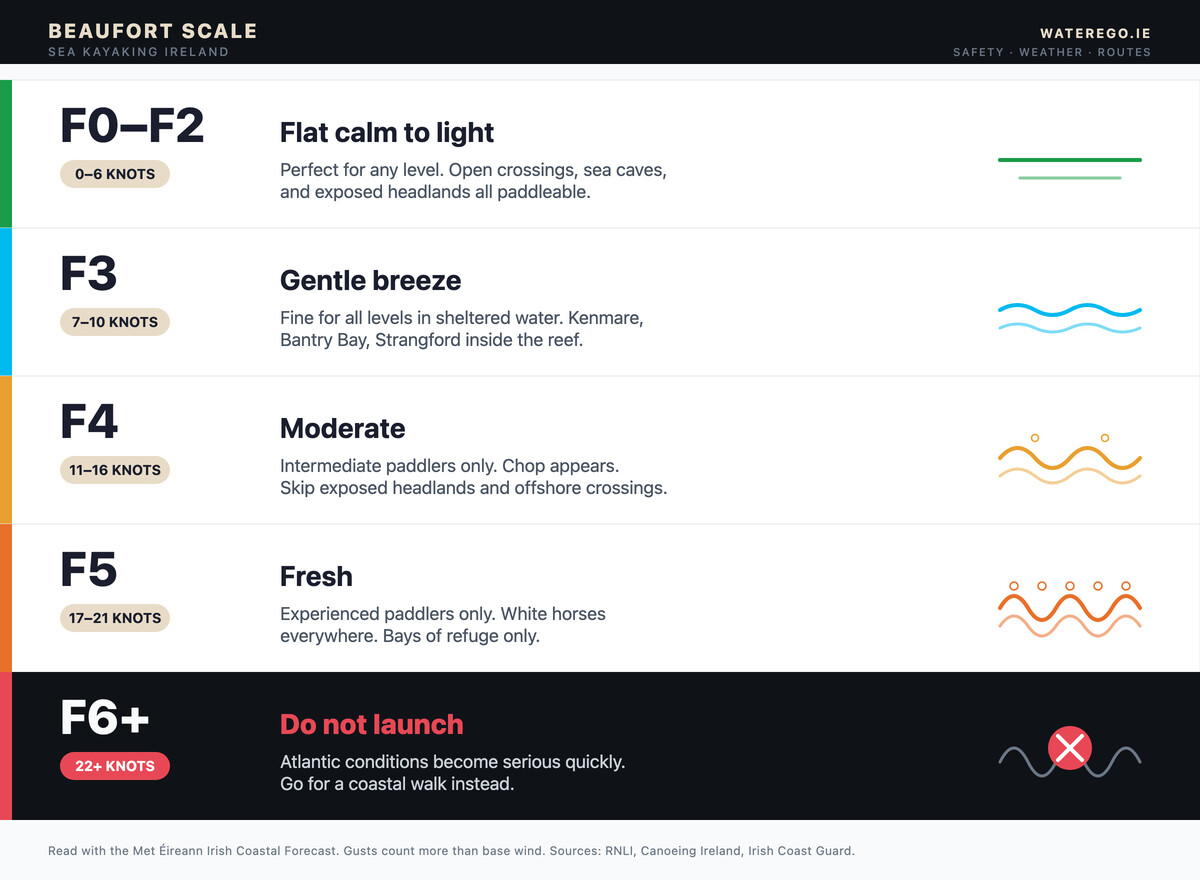
| Beaufort | Knots | What It Means for Kayakers |
|---|---|---|
| F0–F2 | 0–6 | Flat calm to light. Perfect for any level. |
| F3 | 7–10 | Gentle breeze. Fine for all levels in sheltered water. |
| F4 | 11–16 | Moderate. Intermediate paddlers only. Chop appears. |
| F5 | 17–21 | Fresh. Experienced paddlers only. White horses everywhere. |
| F6+ | 22+ | Stop. Do not launch. Go for a walk instead. |
Gusts are more dangerous than base wind speed. A F3 base with F6 gusts behaves like F5. Check both numbers.
British and Irish sea kayak coaches teach the 50/90 rule as a rough go/no-go guide. Add the wind speed in knots to the wave height in inches. Above 50, experienced paddlers only. Above 90, do not launch.
Tides and tidal streams
Tidal range in Ireland is 3 to 5 metres on most coasts. Tidal streams — the moving water — can run at 2 to 6 knots in narrow channels. The Narrows at Strangford Lough reaches 7 knots on spring tides. That is faster than most paddlers can sprint.
Two rules. First, consult a tide table before every paddle. Second, understand the difference between springs and neaps. Spring tides (around full and new moon) have the biggest range and strongest streams. Neap tides are gentler.
Paddle with the tide, not against it. A 3-knot stream turns a comfortable paddle into a treadmill.
Best Sea Kayaking Locations Around Ireland
Every coastal county has paddleable water. Some stand out. The twelve routes below are the ones Irish paddlers return to, year after year.
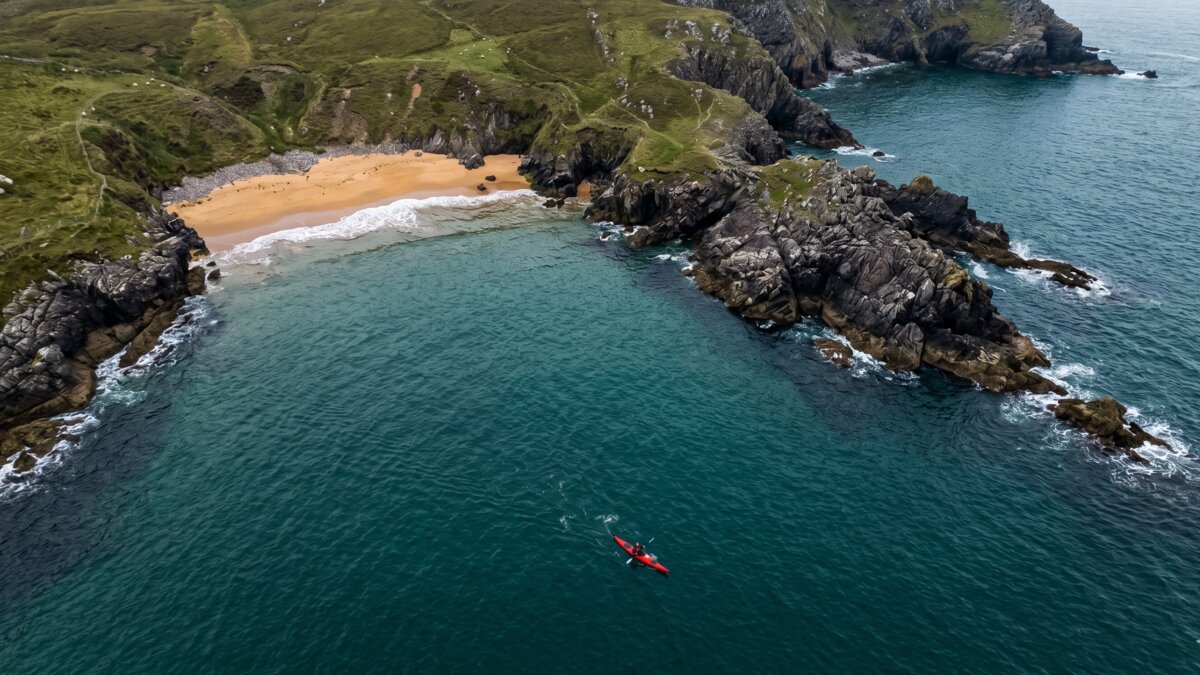
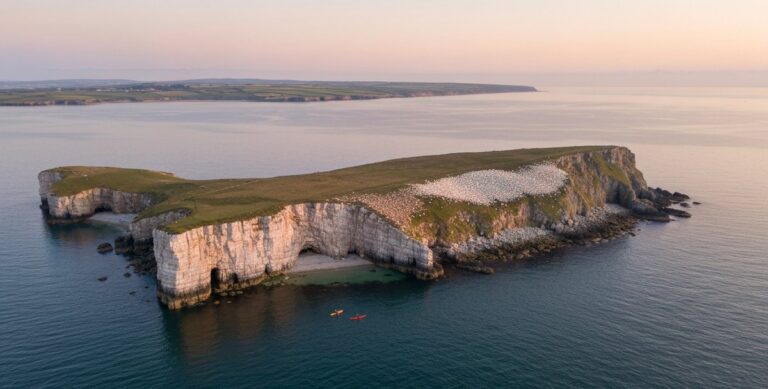
Ireland’s coastline is riddled with sea caves and arches. Hook Head in Wexford, the chambers along the Dingle Peninsula, and the granite stacks of north Donegal are the most paddled. Most serious coastal trips pass at least one.
Marine wildlife is the other reason paddlers come back. Grey and common seals haul out on rocks across the south and west coasts. Bottlenose and common dolphins escort kayakers off Kerry, Mayo, and Donegal — sometimes for kilometres. Gannets dive from cliffs along the Saltees, Skelligs, and Rathlin. Basking sharks pass through west-coast waters between May and August on one of their main Atlantic feeding grounds. Seeing any of these from a sea kayak, at eye level with the water, is the kind of encounter no commercial tour boat can match.
Wild Atlantic Way — South and West Coast
The west coast is where most serious Irish sea kayaking happens. Swell rolls in from thousands of kilometres of open Atlantic, the geology is dramatic, and the marine life is abundant.
- Dingle Peninsula — Kerry’s most famous sea kayaking stretch. Sea caves, arches, and Fungie’s old territory. Go on a settled day or not at all.
- Bantry Bay — Long, deep, sheltered by Beara. Great intermediate paddling with protection from most swells.
- Kenmare Bay — The most forgiving sea kayaking bay in Ireland. Flat water on most days, mountains on both sides, seals everywhere.
- Glengarriff Bay — Tiny, tree-lined, sheltered. Ideal for a first open-water paddle.
- Achill Island — Mayo at its wildest. Keem Bay, the cliffs at Croaghaun, and committing coastline that punishes poor preparation.
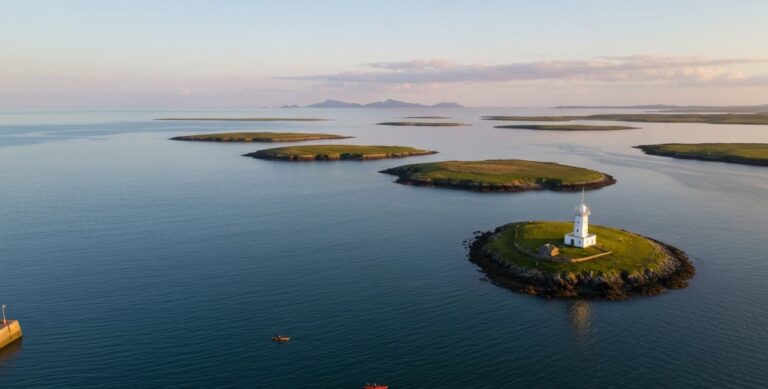
- Clew Bay — Supposedly has an island for every day of the year. Sheltered by Clare Island, endless exploration potential.
- Connemara Coast — Bog, granite, and Atlantic. Killary Harbour is the only proper fjord in Ireland and it is worth a dedicated paddle.
West and North — Galway and Donegal
- Galway Bay — The crossing to the Aran Islands is a serious undertaking. The bay itself gives easier paddling off Salthill.
- Mannin Bay — Hidden gem west of Clifden. The Coral Beach launch gives you access to dozens of tiny islets.
South-East Coast
- Dunmore East — Waterford’s sea kayaking home. Sheltered harbour, easy access, and the Copper Coast stretches west for days of coastal paddling. For a full guide to paddling Waterford, see our kayaking Waterford guide.
- Wicklow coast — The granite cliffs and sea stacks between Greystones and Wicklow Head make for one of the best half-day coastal paddles within easy reach of Dublin.
- Killarney Lakes — Not strictly sea kayaking, but the inland loughs at Killarney — Lower, Middle, and Upper — offer sheltered, scenically unmatched paddling for beginners wanting lake experience before the coast.
Dublin and the East Coast
Dublin Bay and the surrounding coast give sea kayaking opportunities that most visitors overlook. Howth Harbour to the North Bull Island, the Grand Canal Sea Lock, and the rocky sections around Dún Laoghaire all offer accessible paddles within the city’s reach.
Northern Ireland and the Cross-Border Loughs
- Strangford Lough — A tidal lough with some of the strongest currents in Europe at The Narrows. Plan the tide carefully.
- Carlingford Lough — Sheltered, scenic, cross-border. One of the best introduction-to-sea-kayaking environments in the country.
Browse every paddleable route on our interactive map with launch points, difficulty grades, and distance markers.
What to Wear for Sea Kayaking in Ireland
Irish water is cold. The air is rarely warm. And the weather changes during most paddles. Dress for immersion, not air temperature.
Summer (June to September)
Water temperature sits around 13 to 16°C. Most paddlers wear a 3mm wetsuit or a technical paddling top and shorts combination if conditions are settled and they are confident they will stay in the boat.
- Paddling-specific PFD (buoyancy aid), fitted properly
- Neoprene paddling booties
- Sunglasses on a retainer, peaked cap
- Reef-safe sun cream — sea reflects UV intensely
Shoulder Seasons (April–May and October–November)
Water is 9 to 12°C. A drysuit becomes the sensible choice. A thick wetsuit works for short paddles but chills fast in wind.
Winter (December to March)
Water temperature can drop to 7°C. Drysuit, thermal base layer, neoprene hood, and pogies on the paddle. Winter paddling in Ireland is rewarding but unforgiving of errors. It is not beginner territory.
Wetsuit vs drysuit — which one for Ireland?
A wetsuit and a drysuit are different tools, not different price points for the same job. The table below covers what most Irish coaches teach.
| Factor | Wetsuit | Drysuit |
|---|---|---|
| How it works | Traps a thin layer of water against the skin, body heat warms it | Fully waterproof shell with insulating base layers worn underneath |
| Best for | June to September, short paddles, learning to roll in a pool | Year-round, especially October to May, multi-hour exposed trips |
| Cost in Ireland | €120–€220 (3mm full suit) | €500–€1,400 |
| Comfort out of water | Cold and clammy, especially in wind | Warm and dry until you sweat hard |
| If it leaks | Stays warm even with water inside | In winter water, flooding leaves you in seconds-cold |
| Lifespan | 3 to 5 seasons | 8 to 10 years with care and seal replacement |
Most Irish sea kayakers own a 3mm wetsuit for July and August calm bays, and a drysuit for everything else. If you can only afford one piece, buy the drysuit. It is the kit that lets you paddle the other ten months of the year.
The Gear Every Irish Sea Kayaker Needs
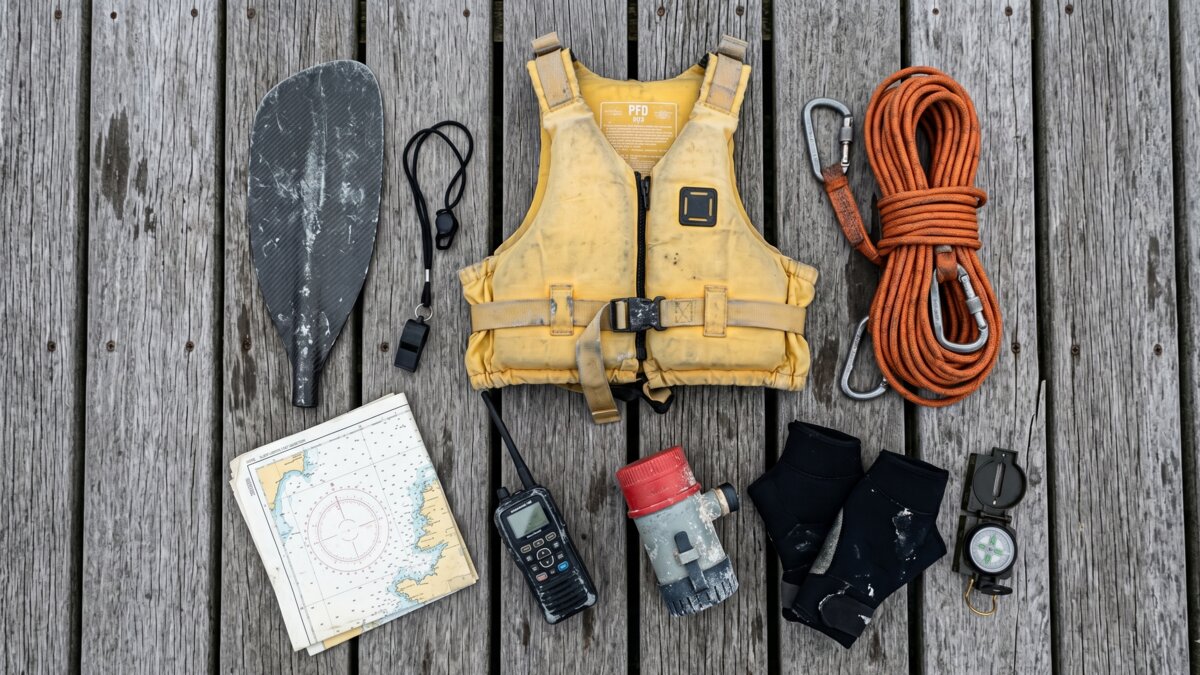
Beyond the boat, paddle, spray deck, and buoyancy aid (PFD — personal flotation device), a responsible sea kayaker in Ireland carries the items below. If you are launching from a pier or slipway, a kayak trolley makes moving a loaded 20-kilogram boat from car to water far easier — especially on stony beaches.
- Tow line — for assisting a tired or injured paddler
- Bilge pump — to empty a swamped cockpit
- Paddle float — for self-rescue on open water
- Whistle — attached to the PFD, for signalling
- VHF (Very High Frequency) radio — essential on exposed paddles. The Coast Guard monitors Channel 16 continuously.
- Paper chart or waterproof map — GPS units fail, screens die
- Compass — either deck-mounted or wrist
- Spare paddle — broken down on the rear deck
- Warm kit in a dry bag — fleece, hat, and a flask of something hot
The cost of a decent setup in Ireland breaks roughly into three tiers:
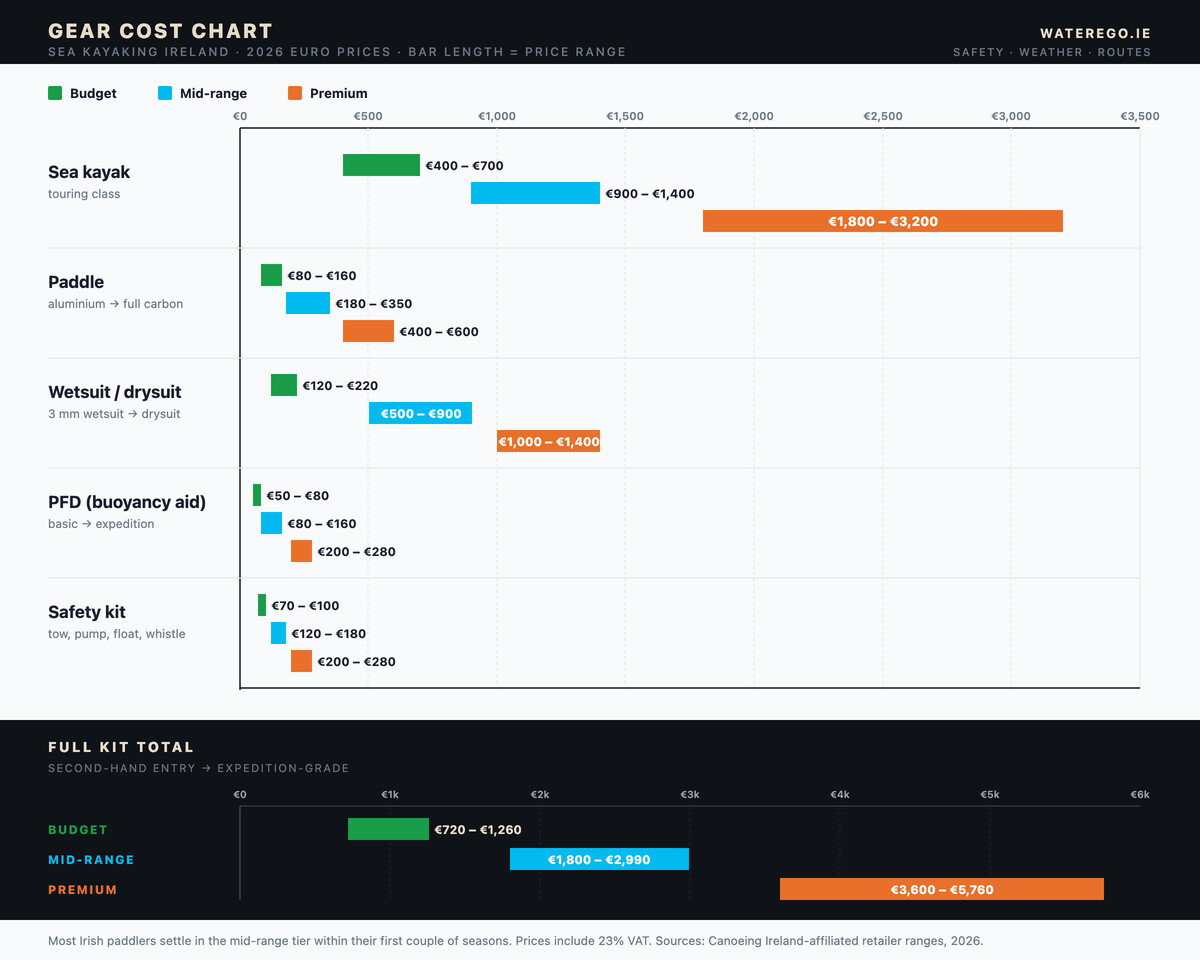
| Item | Budget | Mid-range | Premium |
|---|---|---|---|
| Sea kayak (touring) | €400–€700 (second-hand plastic) | €900–€1,400 (new plastic) | €1,800–€3,200 (composite) |
| Paddle | €80–€160 (aluminium shaft) | €180–€350 (carbon shaft) | €400–€600 (full carbon) |
| Wetsuit or drysuit | €120–€220 (3mm wetsuit) | €500–€900 (entry drysuit) | €1,000–€1,400 (latex-seal drysuit) |
| PFD (buoyancy aid) | €50–€80 (basic) | €80–€160 (touring with pockets) | €200–€280 (high-volume expedition) |
| Safety kit (tow, pump, float, whistle) | €70–€100 | €120–€180 | €200–€280 |
| Total | €720–€1,260 | €1,800–€2,990 | €3,600–€5,760 |
Most Irish paddlers settle in the mid-range tier within their first couple of seasons. A club membership (€30 to €50 a year) often includes access to club boats and safety gear while you build your own kit.
Essential Paddling Strokes
You do not need to know every stroke to start sea kayaking. You do need four — and you need to practise them until they are automatic.
Forward stroke — the engine
The forward stroke moves you through the water. Most beginners paddle with their arms. This is wrong. The power comes from rotating your torso.
Plant the paddle blade near your toes, fully submerged. Rotate your upper body so the blade exits at your hip. Your arms stay relatively straight. The paddle traces a vertical arc, close to the boat. A good forward stroke looks effortless and sounds quiet. A bad one splashes and tires the shoulders in ten minutes.
Sweep stroke — for turning
The sweep is a wide arc from bow to stern, used to turn the boat. Plant the blade at your toes, sweep it outwards in a half-circle, finish at the rear. A forward sweep turns the boat away from the paddle side. A reverse sweep (stern to bow) turns the boat towards the paddle side.
Combine a sweep on one side with a forward stroke on the other and you carve neat turns without losing speed.
Edging — quiet control
Edging is leaning the boat without leaning your body. Lift one hip, drop the other. The boat tilts. The hull shape changes. The kayak turns towards the lowered edge.
Edging does three things: it reduces weather-cocking (the boat trying to turn into the wind), it tightens turns, and it teaches balance. Practise it on calm water before you need it in waves.
Low brace — the catch
The low brace saves you from a capsize. As the boat tips, slap the back of the paddle blade flat on the water. Push down. The buoyancy of the blade pauses the fall. Recover by lifting the blade and re-centring your weight.
Every paddler uses the low brace dozens of times a paddle without thinking about it. Learn it early. Practise it in a pool or sheltered bay until it is reflexive.
A one-day skills course teaches all four strokes in a morning. The rest is repetition on the water.
Launching from a pier
Pier and slipway launches are the standard put-in across Irish harbours. The technique below handles low piers with up to a metre of swell rolling against the wall.
- Lower the kayak into the water parallel to the pier, deck line facing up. Hold one of the deck lines so the boat cannot drift.
- Lay the paddle across the back of the cockpit and onto the pier — the paddle now bridges boat to pier and acts as an outrigger.
- Sit on the pier edge, then transfer your weight onto the paddle-bridge as you slide your hips into the cockpit.
- Drop your legs in one at a time. Keep weight on the bridging hand until the boat settles.
- Attach the spray deck — back edge first, then the sides, last the front grab loop.
- Push off with the paddle.
Landing reverses the sequence. Approach slowly, stop alongside the pier, lay the paddle as the bridge, and step out the same way you came in.
Rescue and Emergency Procedures
Capsizes happen. A good paddler expects them and has practised what to do. A bad paddler hopes they will not happen.
Wet exit — the first skill
A wet exit is how you get out of an upside-down kayak. The spray deck keeps water out of the cockpit, but it also keeps you in when the boat flips. Practise this in a pool or sheltered shallow water on your first day.
Steps: the boat flips, you are upside down. Lean forward and reach for the grab loop on the front of the spray deck. Pull it. The deck releases. Push your hands against the cockpit rim and slide out. You surface next to the boat. Keep hold of the kayak and paddle.
Never let the kayak drift away. It is your flotation and your way home.
Self-rescue — paddle float re-entry
On open water with no help nearby, the paddle float self-rescue gets you back in the boat. Inflate the float, slide it onto one paddle blade, lay the paddle across the rear deck perpendicular to the boat, kick up onto the rear deck using the paddle as an outrigger, swing your legs in, and pump out the cockpit.
It sounds easy. It is not, the first time. Practise it in warm sheltered water before you need it in cold chop.
Assisted rescue — T-rescue
With another paddler nearby, the T-rescue is faster and less tiring. The swimmer holds the bow of the rescuer’s kayak. The rescuer lifts the swimmer’s boat onto their own deck, tips it to drain, rolls it upright, and eases it back into the water. The swimmer climbs back in over the rear deck while the rescuer holds both cockpits together.
This is a club skill. Every intermediate paddler in Ireland can do it. Every accredited Level 2 sea kayak course teaches it.
Calling for help
If you cannot self-rescue and no paddler is nearby, signal for help.
- Three blasts on a whistle means distress. Attached to your PFD, audible at distance.
- VHF Channel 16 is the emergency channel. The Irish Coast Guard monitors it continuously. The message format is: “Mayday, mayday, mayday, this is [kayaker’s name], [location], [nature of emergency], over.”
- 999 or 112 from a mobile asks for the Irish Coast Guard. Ireland has five Coast Guard stations coordinating rescue across the island — Malin Head, Valentia, Dublin, Howth, and Clifden.
The RNLI (Royal National Lifeboat Institution) runs 46 lifeboat stations around Ireland and launches alongside the Coast Guard on most sea rescues. The Coast Guard takes the Mayday; the RNLI often puts the boat in the water.
The Coast Guard does not charge for rescues. Call early. A small problem in February water becomes a fatal one in ten minutes.
Learning to Sea Kayak in Ireland
Ireland’s formal sea kayak training pathway runs through five progressive skills levels. It is the route recognised by insurers, instructors, and the Coast Guard.
The Irish Sea Kayak Coaching Levels
- Level 1 Paddler Award — introduction. Flat water. You can paddle a kayak in a straight line.
- Level 2 Sea Kayak Skills — sheltered coastal. You can do a wet exit, self-rescue, and basic strokes.
- Level 3 Sea Kayak Skills — moderate conditions. Group management, navigation basics, tidal planning.
- Level 4 Sea Kayak Leader — committing conditions. You can lead a trip on exposed coast in up to Force 4 winds.
- Level 5 Sea Kayak Coach — the top instructional qualification. Rare. Highly respected.
Most clubs run Level 1 and 2 courses through the summer. Private providers cover Level 3 and above. Expect to pay €80 to €150 for a one-day beginner course. Multi-day expedition courses run €400 to €700.
The Club Route
For most Irish paddlers, joining a kayak club is the best way to start. You get access to boats and equipment, paddle with experienced members, and learn in a supportive environment. Club membership usually bundles personal accident cover and third-party liability insurance through Canoeing Ireland affiliation — roughly €30 annually.
Find one near you in our clubs and instructors directory.
Best Times of Year for Sea Kayaking Ireland
Every month in Ireland has paddleable days. Some months have more of them.
| Season | What to Expect |
|---|---|
| April–May | Water still cold. Fewer crowds. Some settled spells. Good for intermediate paddlers in drysuits. |
| June–September | The Irish sea kayaking season. Longest daylight, warmest water, most reliable forecasts. July and August are peak months. |
| October–November | Some of the best light of the year, but weather windows shrink. Quality over quantity. |
| December–February | Short days, cold water, and Atlantic storms. Experienced paddlers only. Drysuit non-negotiable. |
| March | Transition month. Water coldest of the year (around 8°C). Wait for settled days. |
The weather, not the calendar, decides. A settled November day can be better paddling than a windy August afternoon.
Check Clean Dry and Common Mistakes
Irish waterways are under pressure from invasive species — zebra mussels, curly-leaf pondweed, and the killer shrimp. They hitch rides on kayaks, PFDs, and spray decks. Moving them between waterways is how they spread.
Check Clean Dry protocol
After every paddle, especially if you paddle multiple waterways in a week:
- Check your boat, paddle, spray deck, PFD, and booties for any organic matter — weeds, mud, snails
- Clean everything with hot water above 45°C or a dilute disinfectant solution
- Dry fully for at least 48 hours before launching in a different waterway
The Invasive Species Ireland campaign provides full guidance, and Waterways Ireland — the cross-border body that manages the Republic’s and Northern Ireland’s navigable inland waters — enforces the same protocol on its network. Clubs check this at every launch. Solo paddlers need to self-police.
Common beginner mistakes
The mistakes below are the ones Irish club coaches see repeated year after year:
- Paddling in offshore winds without understanding you can be blown out to sea
- Skipping the pre-launch check — spray deck fit, PFD zipped, hatches sealed, float plan filed
- Dressing for air temperature instead of water temperature
- Paddling alone before having a bombproof wet exit and self-rescue
- Ignoring the tide tables, then fighting the ebb all the way home
- Using a short recreational kayak in 1-metre swell — the wrong boat for the conditions
- Carrying no means of signalling — no whistle, no VHF, no mobile in a dry pouch
- Trusting yesterday’s forecast on today’s paddle
- Paddling in a group without agreed hand signals or a group leader
- Pushing on when conditions have already worsened past your limits
Every one of these is preventable. Every one costs lives somewhere in the UK and Ireland every year.
12 Frequently Asked Questions
Where is the best sea kayaking in Ireland?
The west coast — Kerry, West Cork, Connemara, and Mayo — offers the most dramatic paddling, with the Dingle Peninsula, Bantry Bay, Clew Bay, and the Connemara coastline as the standout destinations. For sheltered beginners’ water, Kenmare Bay and Glengarriff are hard to beat. On the east coast, Dublin Bay and the Wicklow coast are accessible and often overlooked. Northern Ireland’s Strangford Lough is one of Europe’s finest tidal paddling venues. The right answer depends on your skill level, where you are based, and the day’s forecast.
Do you need a licence to sea kayak in Ireland?
No. There is no licence required to sea kayak in Ireland, either in the Republic or Northern Ireland. The Coast Guard and accredited training providers strongly recommend basic training and club membership, but there is no legal requirement.
Can beginners go sea kayaking in Ireland?
Yes, but not alone and not in open water without supervision. Beginners should start with a club, a course, or a guided paddle in a sheltered bay. Kenmare Bay, Glengarriff, and Carlingford Lough are among the most beginner-friendly environments in Ireland.
Is sea kayaking hard to learn?
The basics come quickly. Most first-time paddlers can keep a kayak tracking straight and turn it within a single session. What takes longer is reading weather and tides, handling a capsize calmly, and developing the judgement to know when not to launch. Expect a season of regular paddling to reach a confident intermediate level, and years to become a skilled sea paddler on exposed Irish coasts.
What is the best kayak for Irish sea conditions?
A hard-shell sea kayak between 4.8 and 5.4 metres long with two bulkheads, deck lines, and either a skeg or a rudder. A skeg is a retractable fin that drops from under the stern to help the boat track straight in crosswinds — no moving foot pedals, less to break, preferred by most Irish sea paddlers. A rudder is a pivoting blade at the stern controlled by foot pedals — more steering authority on heavy following seas, but more cables and linkages to maintain in salt water. Plastic construction handles Irish rocks well. Composite boats are faster but more fragile. Avoid short recreational kayaks and basic sit-on-tops for anything other than a sheltered summer paddle.
How dangerous is sea kayaking in Ireland?
It is a risk-graded activity. In sheltered water on a settled day it carries low risk — comparable to hill walking. On exposed coast in poor weather it is serious — comparable to winter mountaineering. The danger is proportional to the conditions and the paddler’s skill level.
Is sea kayaking good exercise?
Yes. A steady coastal paddle burns roughly 400 to 600 calories an hour for an average adult, more in chop. It works the core, shoulders, back, and grip strength continuously, and because you rotate through every stroke the load spreads rather than stressing one muscle group. Unlike running, it is low-impact on knees and ankles. Most sea paddlers find it meditative as well as aerobic.
What qualifications do Irish sea kayaking instructors have?
Professional instructors hold a Level 3 Sea Kayak Leader qualification at minimum, with many holding Level 4 or Level 5 Coach awards. Always ask to see current qualifications before booking a course with an unfamiliar provider.
Where can I hire a sea kayak in Ireland?
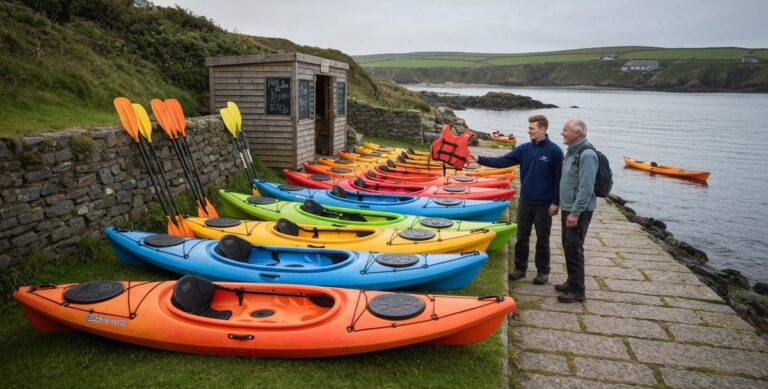
Guided tour operators in Dingle, West Cork, Connemara, and Donegal all offer sea kayak hire, usually bundled with instruction. Solo hire is rare and not generally recommended for the open sea. For options across the country, see our kayak rental Ireland guide.
Is a river kayak the same as a sea kayak?
No. River kayaks are short (2.5 to 3 metres), wide, and designed to spin on the spot in whitewater. Sea kayaks are long (4.5 to 5.5 metres), narrow, and built with bulkheads and deck lines to track straight on open water. A river kayak in a one-metre swell is uncomfortable and slow. A sea kayak on a fast river is unmanageable. They are different boats for different water.
Can children go sea kayaking in Ireland?
Yes, with the right boat and supervision. Most Irish clubs welcome paddlers from around age eight in tandem sea kayaks, or in the front cockpit of a parent’s double. From around twelve, capable children can manage a small solo sea kayak in sheltered water under one-to-one coaching. Always in a properly fitted PFD, always within reach of an adult, and never on exposed coast.
How fast is a sea kayak?
A relaxed cruising pace is 4 to 5 km/h (around 2.5 knots). A fit paddler in calm conditions can hold 6 to 7 km/h (about 3.5 knots) for hours. Sprint speed for short bursts approaches 9 to 10 km/h. Wind, swell, and tide change real-world speed dramatically — paddling against a 2-knot tidal stream cuts your over-ground speed nearly in half.
Final Word — Putting It All Together
Sea kayaking in Ireland is not one skill. It is half a dozen — reading weather, reading tides, paddling strokes, self and assisted rescue, navigation, and the judgement that decides when not to launch. Each one is learnable. None of them is optional.
The shortest honest summary of this guide:
- Match the day to your level. Check Met Éireann’s marine forecast every morning. F4 is the line for most paddlers. Offshore wind needs more caution than onshore.
- Wear immersion clothing. Wetsuit October to May, drysuit if you can stretch to it. Irish water is cold all year.
- Carry the safety kit. PFD on, spray deck on, tow line, paddle float, whistle, VHF on Channel 16 for committed coastal paddles. Phone in a waterproof case.
- Build skills with a club or an accredited instructor. Self-taught sea kayakers exist, but the casualty rate is higher. Canoeing Ireland levels are the recognised qualification framework.
- Start sheltered, build up. Kenmare Bay or Glengarriff before Dingle. Dingle before Achill. Achill before any committed crossing.
Get those five right and Irish sea kayaking goes from intimidating to one of the best things this island offers.
Start Paddling
If you are ready to start, browse our 30 paddling routes across Ireland, find a club or instructor near you, or check today’s conditions before heading out.
Also Read
- Sea Kayaking West Cork — Bioluminescence, Lough Hyne, and the Beara Coast — Ireland’s richest sea kayaking coastline
- Kayaking Dublin — Dublin Bay, the Liffey, and East Coast Paddles — where to launch in and around the capital
- Kayaking Waterford — the Suir, Dunmore East, and the Copper Coast — a full guide to paddling the south-east
- Kayaking Killarney — Lakes, Mountains, and the Reeks — the most scenic inland paddle in Ireland
- Kayaking Wicklow — Sea Stacks, Granite Cliffs, and Hidden Coves — the east coast’s finest coastal paddling
- Kayak Trolley Ireland — How to Choose the Right Cart for Slipways and Beaches — essential if you are launching solo
- Kayaking the Killarney Lakes — Full Route Guide — Ireland’s most forgiving introduction to bigger water
- Kayaking the Dingle Peninsula — Sea Cave and Arch Guide — Kerry’s best-known sea paddling stretch
- Kayaking Strangford Lough — Tidal Paddling Guide — Northern Ireland’s classic sea kayaking destination
- Find a Kayaking Club or Certified Instructor Near You — accredited kayaking clubs across all 32 counties
- Interactive Map of Every Paddling Route in Ireland — Filter by difficulty, water type, and county

No comments yet on this route.
Be the first to share your experience — conditions, access, hazards, or anything a future paddler should know.
Login to join the discussion