Kayaking for beginners in Ireland is one of the most accessible ways to get on the water. A first paddle on a sheltered lake or canal takes ninety minutes, costs under €40 with a guided session, and needs no prior experience. Most beginners learn the basic forward stroke, a sweep turn, and how to stop within the first hour. The hard part is not the paddling — it is choosing the right place, the right conditions, and the right gear for Irish water.
This guide walks you through everything a complete beginner needs to know before that first paddle. Real Irish locations, real Canoeing Ireland course pricing, real beginner mistakes to avoid, and the cold-water reality of paddling in 9°C lake water in March. By the end you will know exactly what to book, what to wear, and what to expect.
What Is Kayaking
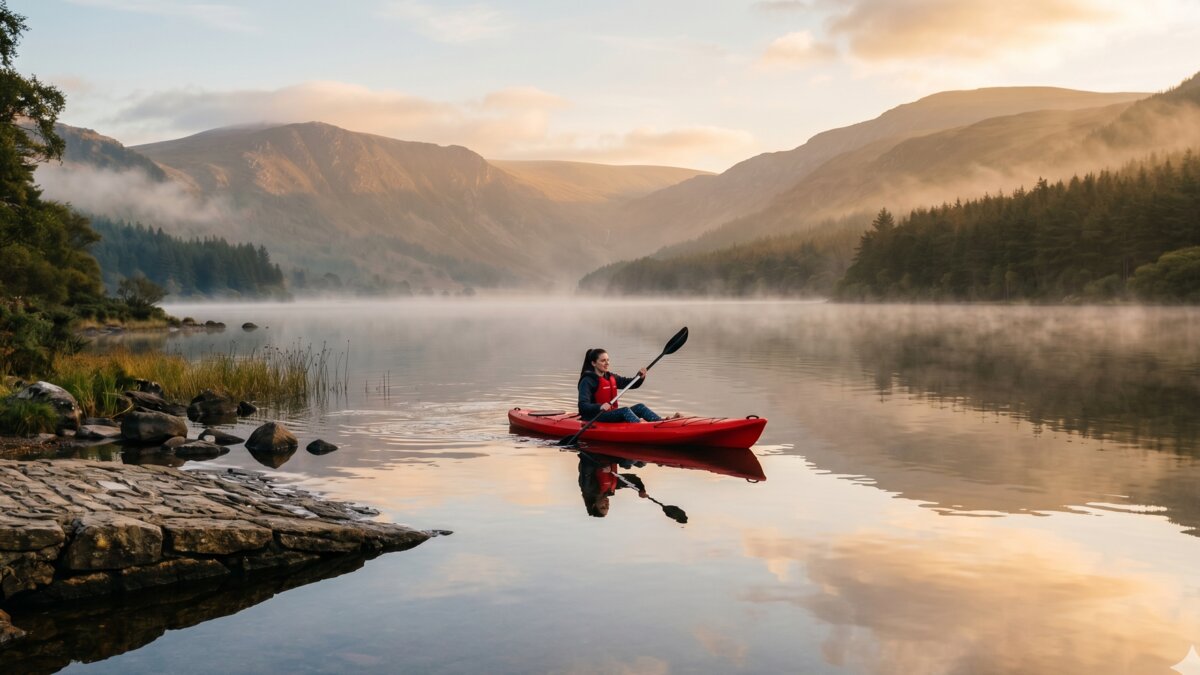
Kayaking is a paddling sport where you sit in a small narrow boat — the kayak — and propel it with a double-bladed paddle. One blade on each side, alternating strokes. The kayak is closed-deck (sit-inside) or open-deck (sit-on-top), and the choice between the two is the first decision a beginner makes.
There are five main kayak categories you will hear about in Ireland:
- Recreational kayak — wide, stable, 2.7 m to 3.6 m long. The default beginner boat. Used on lakes, canals, and slow rivers.
- Sit-on-top kayak — open deck, you sit on top of the hull, no spray deck needed. Easier to get into, harder to swamp, the choice for warm-day rentals.
- Sea kayak — long (5 m or more), narrow, fast, designed for open water. Not a beginner boat unless you are on a course with an instructor.
- River or whitewater kayak — short, manoeuvrable, designed for moving water and rapids. Specialist discipline.
- Touring kayak — between recreational and sea kayak. Faster than recreational, more forgiving than sea.
For your first paddle in Ireland, you want a recreational kayak or sit-on-top on sheltered flatwater. Lakes, canals, blueways, and sheltered bays. The Atlantic coast and rough surf are not where beginners start.
Kayaking is often confused with canoeing. The difference: a canoe is open-deck and uses a single-bladed paddle from a kneeling or seated position. A kayak is enclosed (or sit-on-top) and uses a double-bladed paddle. In Ireland the governing body for both is Canoeing Ireland — confusingly named, but the same organisation handles kayak certification.
Is Kayaking Hard, Safe, or Easy for Beginners
This is the question every beginner types into Google before their first paddle. The honest answer has three parts.
Is kayaking easy to learn?
The basic forward stroke takes about ten minutes to learn. The sweep turn — the most useful manoeuvre for a beginner — takes another ten. By the end of an hour on flatwater, a complete beginner can paddle in a straight line, turn the boat, and stop. Compared to surfing, sailing, or windsurfing, kayaking has one of the shortest learning curves of any water sport.
Is kayaking hard for beginners?
The paddling is not hard. What is hard is reading the water, the wind, and your own limits. A beginner who launches into Dublin Bay in a Force 4 will struggle even with perfect technique. A beginner on Lough Derg on a settled summer evening will have no difficulty at all. The skill that takes time is judgement, not paddle strokes.
Is kayaking safe?
Kayaking in Ireland is safe when you match the conditions to your skill level. The Irish Coast Guard records around 1,200 marine incidents a year across all water-users, and the leading causes for paddlers are cold-water immersion, separation from the boat, and going out alone in conditions above their level. The fix is simple: wear a PFD (personal flotation device), tell someone your plan, check the forecast, and start on sheltered water with an instructor or experienced friend. Done that way, the risk is low.
The single biggest beginner mistake is underestimating Irish water temperature. See the cold-water section below.
Gear You Need for Your First Paddle
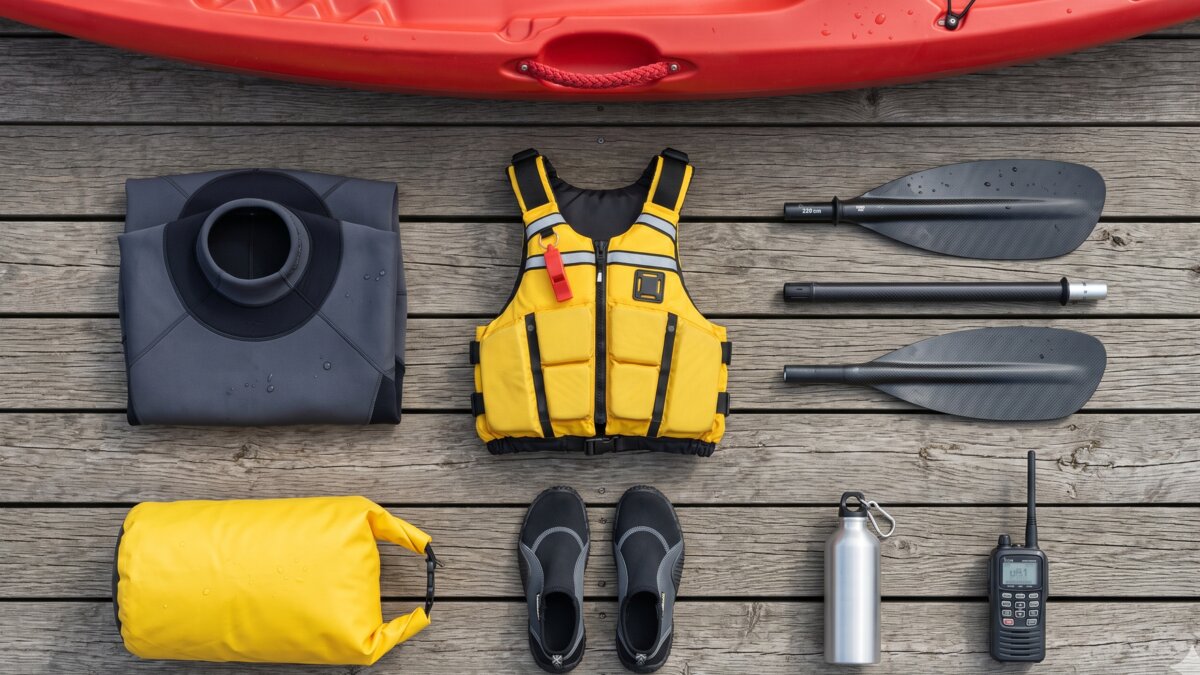
For a guided session or rental, the operator provides everything. You arrive in old clothes and walk out two hours later having spent €25 to €40. If you are paddling outside a session, here is what you need.
Mandatory gear
| Item | What it is | Budget (€) | Notes |
|---|---|---|---|
| Kayak | Recreational or sit-on-top | Rent €15/hr or buy €350–€700 | Borrow first, buy later |
| Paddle | Double-blade, 220–230 cm for most adults | €50–€150 | Length depends on height + kayak width |
| PFD | Buoyancy aid, certified to EN ISO 12402-5 | €60–€120 | Non-negotiable, wear it every time |
| Spray deck (sit-inside only) | Skirt that seals you in the boat | €35–€90 | Not needed for sit-on-top |
A PFD is the only piece of kit that has saved more Irish paddlers than any other single item. Buy one that fits. A buoyancy aid that rides up over your face in the water is worse than useless.
Clothing for Irish conditions
Cotton kills. It absorbs water, loses all insulation, and gets you cold fast. Wear synthetic or wool base layers, never cotton, even in summer.
| Season | Water temp | Recommended kit |
|---|---|---|
| Summer (Jun–Aug) | 13–17°C | Quick-dry shorts + synthetic top + sun hat |
| Spring/Autumn (Apr–May, Sep–Oct) | 9–13°C | 3 mm wetsuit or thermal base + paddling jacket |
| Winter (Nov–Mar) | 6–9°C | 5 mm wetsuit or drysuit + thermal base + neoprene boots and gloves |
A wetsuit lets cold water in, your body heats it, and the thin trapped layer keeps you warm. A drysuit keeps the water out entirely. For beginners paddling sheltered Irish lakes in summer, a 3 mm shorty wetsuit is fine. For sea paddling year-round, a 5 mm wetsuit or proper drysuit is the standard.
Useful but optional
- Helmet — needed for whitewater and rock-hopping. Not needed for flatwater.
- Tow line — clipped to your PFD, used to tow a tired paddler. Useful from day one if you paddle in a group.
- Whistle — attached to the PFD shoulder strap. Cheap, audible, mandatory for any sea paddle.
- Waterproof phone case or dry bag — for keys, phone, snacks.
Real Irish retail prices for a complete beginner setup (kayak, paddle, PFD, spray deck if relevant) sit in three tiers:
- Budget (used or entry-level): €350–€600 total
- Mid-range (new entry-level new): €600–€1,100 total
- Premium (touring or sea-grade): €1,200+
Most beginners borrow or rent for the first three to five sessions, then buy used. Marketplace, DoneDeal, and the second-hand sections of Canoeing Ireland club noticeboards are where Irish paddlers find their first kayak.
Basic Strokes and Techniques Every Beginner Should Learn
You do not need to master every paddling stroke before your first session. You need four. Get these right and you can paddle anywhere flat and sheltered.
Forward stroke
The stroke that moves the boat forward. Three phases:
- Catch — rotate your torso, place the blade in the water near your feet
- Power — rotate your torso back while the blade stays planted, pulling the boat past the blade
- Exit — lift the blade out of the water at your hip
Power comes from torso rotation, not arm muscles. Beginners who paddle with their arms tire in twenty minutes. Beginners who paddle with their core can keep going for hours.
Reverse stroke
The forward stroke run backwards. Used to stop, back up, or reposition. Plant the blade behind your hip, push the boat backwards with torso rotation, exit at your feet.
Sweep stroke
The turning stroke. Plant the blade near your feet and sweep it in a wide arc out to the side and around to your hip. A wide arc on the right turns the boat left. A wide arc on the left turns the boat right. Two or three sweep strokes turn a recreational kayak 90 degrees.
Low brace
The stability stroke. When you feel the kayak tipping, slap the flat of the blade onto the water surface on the tipping side. The flat blade pushes against the water and stops you going over. The low brace is the single most useful skill a beginner can have — it prevents nine out of ten capsizes.
What comes next
Once you are comfortable with the four basics, the next skills to learn are:
- Draw stroke — moves the boat sideways without turning. Useful for docking and rafting up.
- Edging — tilting the boat with your hips to help it turn faster.
- Wet exit and self-rescue — what to do if you do capsize. Practised in a controlled pool or shallow water session.
These are taught on Canoeing Ireland Level 1 courses. You can also pick them up from a paddling club mentor or an experienced friend. Do not try to learn them from a video alone.
Best Beginner-Friendly Spots in Ireland
Ireland has hundreds of sheltered launch points. These are the places to go on your first three or four paddles — flat water, easy access, low risk, scenic enough that you will want to come back.
Lakes
- Lough Derg — the Shannon’s biggest lake, plenty of sheltered coves on the eastern shore. Mountshannon Pier is a beginner-perfect launch.
- Lough Corrib — Galway’s flat-water classic. Oughterard side has gentle bays and beginner-friendly bays.
- Lough Leane — Killarney’s lower lake. National park shoreline, mountain backdrop, sheltered most days. Ross Castle slipway is the standard launch.
Canals and blueways
- Royal Canal — the most beginner-friendly water in Ireland. No tide, almost no current, water rarely deeper than 2 metres. The Maynooth–Kilcock stretch is flat, scenic, and a perfect first-paddle environment.
- Shannon Blueway — the developed paddling trail along the Upper Shannon. Drumshanbo–Leitrim Village is a 6 km flatwater section with rest stops and shore access.
Sheltered sea bays
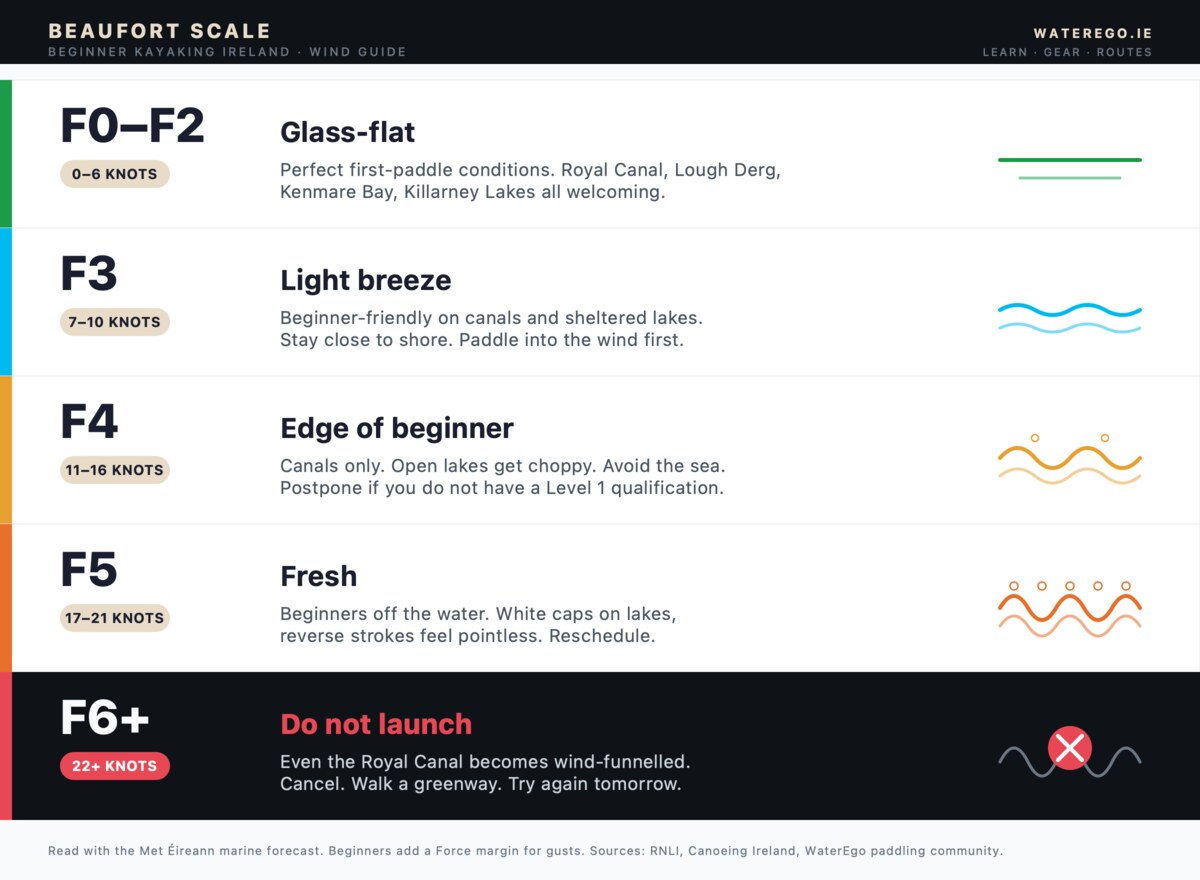
- Kenmare Bay — Kerry’s calmest sea-paddling water. The inner bay is sheltered from Atlantic swell by Beara and Iveragh peninsulas. Best on a settled summer day, never on a south-westerly above Force 4.
Rivers (slow sections)
- River Lee — Cork City’s slow-flow river. The Lee Fields stretch is flat, urban, and beginner-friendly.
- River Liffey — Dublin’s river. The Strawberry Beds–Lucan section is slow-moving, scenic, and a popular beginner outing for Dublin clubs.
Avoid the Atlantic coast for the first ten sessions. The west and north-west are sea-kayak territory and the conditions change fast. Build your confidence on lakes and canals first.
For a wider picture of flatwater paddling in Ireland, the Blueways Ireland guide covers every developed paddling trail in the country. Once you are ready for sea paddling, the Sea Kayaking Ireland pillar covers the progression from sheltered bays to open-coast routes.
Where to Take Kayaking Lessons in Ireland
Every region has at least one Canoeing Ireland accredited provider. The directory below covers the operators who run regular Level 1 and Level 2 beginner courses, by county.
Dublin and east coast
- Kayaking.ie (Dublin Bay, Dalkey, Howth) — group tours suitable for absolute beginners. Three-hour Dalkey Island session is the standard starter.
- Shearwater Sea Kayaking (Howth) — half-day, full-day, and weekend beginner sea kayak courses. Starts in sheltered Howth Harbour before venturing onto open coast.
- Adventure Activities Ireland (Wicklow) — multi-discipline operator, beginner kayak sessions on Avonmore river and Wicklow lakes.
Cork, Kerry, and the south
- Gecko Adventures (Courtmacsherry, Cork) — Canoeing Ireland Level 1, Level 2, Level 3 weekend courses, plus standalone Sea Safety days. Strong educational reputation.
- Atlantic Sea Kayaking (Reen Pier, West Cork) — guided trips and beginner-friendly Lough Hyne sessions, including the famous bioluminescent night paddle.
- Outdoors Ireland (Killarney) — Lough Leane beginner sessions, multi-day packages combining kayak with hike or climb.
Galway, Connemara, and the west
- Killary Adventure Centre (Galway/Mayo border) — fjord paddling for beginners on sheltered Killary Harbour. Family-friendly.
- Burren Outdoor Education Centre (Clare) — Galway Bay and Burren coast sessions, group courses.
Limerick and Shannon region
- Nevsail Watersports (Limerick city) — Shannon and Doonbeg sessions. Kids’ courses, family bookings.
- Adventure Activities at the University of Limerick — public Saturday courses on the Shannon.
Northern Ireland
If you are paddling in the north, Causeway Coast Kayaking and Drumahoe Outdoor Pursuits run beginner sessions under the British Canoeing system. Different certification, same skill base.
You can find the full Canoeing Ireland accredited provider list on the canoe.ie provider directory. The names above are the ones with the longest beginner-track records.
Canoeing Ireland Level 1 to Level 2 Pathway
If you want to paddle independently in Ireland — not just turn up to guided trips — the qualification you need is Canoeing Ireland Level 2 Kayak. That is the entry point to most club outings, university trip nights, and the path toward instructor certification.
Level 1 — Discover Kayak
A weekend introduction. Usually two days, six hours each, or four evenings spread over a month. You learn:
- Basic flatwater strokes — forward, reverse, sweep, stopping
- Equipment management — fitting a PFD, sizing a paddle, getting in and out of a kayak
- Self-rescue basics — wet exit (sit-inside), re-entry (sit-on-top)
- Weather and tide basics — checking a marine forecast, understanding Beaufort scale
- Group safety — staying with your group, communication signals
- Capsize drill — controlled tip-over in shallow water
At Level 1 you can paddle in benign conditions under instructor supervision. Standard course price in Ireland: €160 for a weekend. Some providers run intensive one-day versions for €100–€130.
Level 2 — Skills Award
The independent-paddler qualification. Another weekend, often combined with Level 1 in a four-week evening course. Builds on Level 1 with:
- Low brace, draw stroke, edging
- T-rescue (rescuing another paddler)
- Towing a tired paddler
- Reading water — wind shadow, fetch, current
- Trip planning — picking a route, identifying escape routes, communicating a plan ashore
- Cold-water safety — recognising and managing hypothermia symptoms
After Level 2 you are signed off as a paddler who can join most club trips and run your own outings within your assessed skill level. Standard course price in Ireland: €160 for a weekend. Combined Level 1 and Level 2 in a four-week course typically runs €280–€320.
What comes after Level 2
- Level 3 Sheltered Water — more advanced strokes, group leadership basics, deeper rescue technique
- Level 4 Moderate Water — open-coast paddling, surf and tide work
- Level 5 Advanced Water — committed sea trips, rough water competence
- Instructor track — Level 1 Instructor, Level 2 Instructor, etc. — start at Level 4 paddler.
Most recreational paddlers stop at Level 2 or Level 3. That is enough to enjoy Irish kayaking for life.
What Kayaking Costs in Ireland
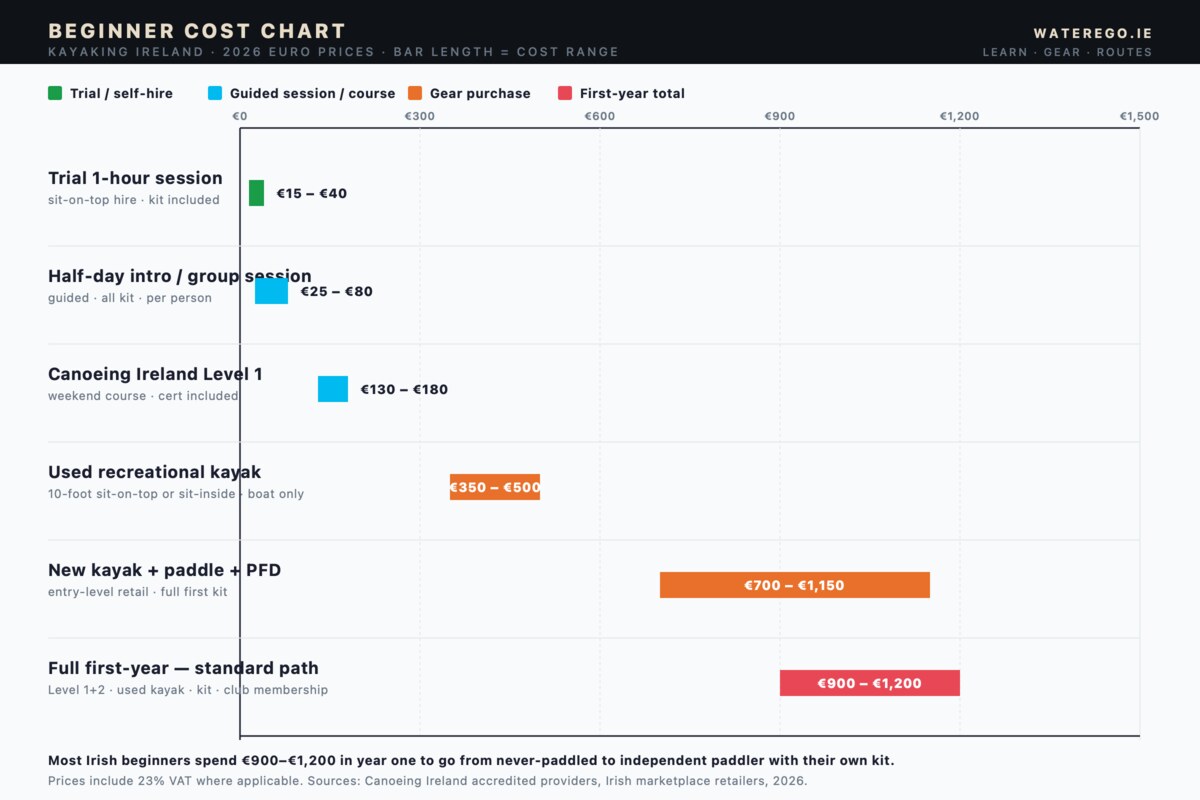
Here is the realistic full-year cost for a beginner who wants to go from never-paddled to comfortable independent paddler.
One-off trial (€25–€80)
- Guided 1-hour rental (sit-on-top): €15 first hour, €10 thereafter
- Group beginner kayak session: €25–€40
- Sea kayak introduction half-day: €40–€60
- Sea Safety full-day course: €80
First-year qualifications (€280–€420)
- Canoeing Ireland Level 1 weekend: €160
- Canoeing Ireland Level 2 weekend: €160
- Optional combined Level 1+2 four-week course: €280–€320
Your first kayak (€350–€1,200)
- Used recreational kayak (10-foot, sit-inside or sit-on-top): €350–€500
- New entry-level recreational kayak: €500–€800
- Used sea or touring kayak: €600–€1,200
- Paddle, PFD, spray deck (full new kit): €200–€350
Ongoing costs (€100–€300 per year)
- Canoeing Ireland membership: €60–€80 individual / €120 family — includes insurance for organised paddles
- Local club membership: €40–€100 depending on club facilities (storage, transport, training)
- Insurance top-up (private, optional): €50–€100
Realistic first-year total
- Minimum (rent + Level 1 only): €200
- Standard (Level 1+2, used kayak, basic kit, club membership): €900–€1,200
- Full kit-out (new gear, Level 1+2, sea + recreational kayaks, full club): €2,500+
Most beginners spend €900–€1,200 in year one. After that, ongoing costs drop to club fees + occasional gear replacement.
Cold-Water Shock and Irish Water Temperatures
This is the section every Irish beginner kayak guide should lead with, and almost none of them do.
Irish water is cold all year round. Inland lakes peak at 17°C in August. The Atlantic coast peaks at 15°C. In March, Irish lake water is 6–9°C. At those temperatures, cold-water shock kills more inexperienced paddlers than capsizes, rapids, or rough weather combined.
Irish water temperature by month
| Month | Lake (°C) | Coast (°C) | Risk |
|---|---|---|---|
| Jan | 5–7 | 8–10 | Extreme cold-water shock risk |
| Feb | 5–7 | 8–10 | Extreme |
| Mar | 6–9 | 8–10 | High |
| Apr | 8–11 | 9–11 | High |
| May | 11–14 | 10–12 | Moderate |
| Jun | 13–16 | 12–14 | Moderate |
| Jul | 15–17 | 14–16 | Lowest risk |
| Aug | 15–17 | 14–16 | Lowest risk |
| Sep | 13–16 | 13–15 | Moderate |
| Oct | 10–13 | 12–14 | Moderate to high |
| Nov | 8–11 | 10–12 | High |
| Dec | 6–8 | 9–11 | Extreme |
What cold-water shock does
When you fall into water below 15°C, three things happen:
- First 60 seconds — gasp reflex. Your body inhales involuntarily. If your face is underwater you breathe water. Number-one cause of cold-water drowning.
- First 10 minutes — swim failure. Your arms and legs lose strength and coordination. You cannot swim back to the boat.
- First hour — hypothermia. Body core temperature drops, you lose consciousness.
This is why a beginner in Ireland wears a PFD every single time, even on a calm summer lake. The PFD keeps you afloat through the first 60 seconds of gasp reflex, when you cannot help yourself.
The simple rules
- Dress for the water, not the air. A 22°C summer day with 12°C water is still cold-water territory.
- Wear the PFD even in summer. Most cold-water drownings happen in calm conditions with no PFD.
- Stay with the boat. A swamped kayak floats. You and the boat together are visible from the shore. You alone in the water are not.
- Practice your wet exit before you need it. Controlled, shallow, with someone watching. Once you know what cold water feels like on your face you will respect it.
In an emergency on Irish water, the number is 999 or 112, ask for Coast Guard. They will dispatch from the nearest of the five Irish Coast Guard helicopter and lifeboat stations.
The Irish Water Safety site is the authoritative source for cold-water and drowning prevention guidance in Ireland.
First-Paddle 90-Minute Checklist
For the first time you put a kayak in Irish water, run this checklist start to finish. It will save you the three most common beginner mistakes.
Pre-launch (45 minutes before)
- [ ] Check Met Éireann marine forecast — wind under Force 3 for first paddle
- [ ] Check tide times if paddling tidal water — slack or rising on a sheltered coast is safest
- [ ] Tell one person ashore your plan — where launching, where returning, expected time back
- [ ] Eat — paddling burns calories, low blood sugar amplifies cold-water risk
- [ ] PFD on before you touch the boat
- [ ] Whistle clipped to PFD shoulder strap
- [ ] Phone in dry bag, accessible
- [ ] Spare paddle if going more than 500 m from shore
On-water (during paddle)
- [ ] Stay within sight of your launch point for the first session
- [ ] Stay within 100 m of shore for the first three sessions
- [ ] Practise stopping every 5 minutes — boat-handling reflex matters more than distance covered
- [ ] If wind picks up to Force 4, head in immediately
- [ ] If you feel cold, head in immediately — do not push through
- [ ] No alcohol, ever, on the water
Return (after paddle)
- [ ] Rinse kit with fresh water — saltwater destroys gear fast
- [ ] Hang wet clothes to dry — never leave wet kit in a bag
- [ ] Check the boat for damage
- [ ] Tell the person ashore you are back safe
- [ ] Eat and drink — paddling depletes you more than it feels
This checklist is borrowed from the standard pre-session brief used by Canoeing Ireland providers. The full club version adds a buddy-system check and group sign-off, but for a first paddle, this is the core.
Common Beginner Mistakes in Ireland
These are the errors that show up over and over in Coast Guard reports and Canoeing Ireland instructor debriefs.
Going out alone on the first paddle
A first paddle should never be solo. Even a sheltered canal section has hazards — boat handling errors, sudden weather, dropped paddle. Paddle with one experienced friend, with an instructor, or with a club. The Royal Canal is busy enough that someone is usually nearby. A remote lake on a Tuesday morning is not.
Underestimating wind
Force 3 (gentle breeze, 10–16 km/h) is fine for a beginner on sheltered water. Force 4 (15–28 km/h) is at the upper edge of beginner-friendly. Force 5 and above is intermediate territory. Check the forecast — Met Éireann gives Force scale, BBC Weather gives mph, both work. The mistake is assuming a Force 4 onshore wind is fine because the launch beach is calm. It is fine until you paddle 300 m out and try to come back into the wind.
Wearing cotton
Cotton holds water, loses all insulation, and stays heavy and cold for hours. Wearing a cotton t-shirt and shorts on an Irish lake in May is the single most common beginner clothing error. Synthetic base layers (€15–€30) solve the problem permanently.
Not wearing the PFD
The PFD is left in the boat or worn loose. In a capsize it floats away or rides up around your face. A PFD must be on, zipped, and adjusted so it cannot pull up past your ears when lifted from the shoulders. Test it on dry land before launch.
Buying a kayak first, learning second
A common pattern: buy a cheap sit-on-top from Lidl or Decathlon, head to the nearest lake, get a fright, never use the kayak again. The right order is rent or borrow for three to five sessions, take a Level 1 course, then buy. By that point you know what kind of paddling you actually enjoy and can choose a boat for it.
Ignoring the tide
If you paddle on a tidal river, estuary, or sheltered coastal bay, the tide moves you. A Force 2 wind plus a 1.5-knot tide can take a beginner 500 m off-line in twenty minutes. Check tide tables at tidetimes.org.uk/ireland and plan to paddle with the tide, against it, or at slack water.
Not checking the forecast within four hours of launch
Irish weather changes fast. The forecast at 8 am is not the same as the one at noon. Check Met Éireann immediately before launch and one more time if you are paddling more than two hours. Local club WhatsApp groups are useful — experienced members will call off a session if conditions turn.
Also Read
- Sea Kayaking Ireland — Complete Guide — the next step once you are comfortable with sheltered water
- Blueways Ireland — Every Paddling Trail Mapped — beginner-friendly flatwater trails across the country
- Kayaking West Cork — Complete Paddler’s Guide — Lough Hyne, Bantry Bay, and the south-west coast
- Kayak Trolley Ireland — Getting Your Boat from Car to Water — practical kit for solo launches
- Canoeing Ireland Clubs Directory — find a club near you for ongoing training and trips
Frequently Asked Questions
Is kayaking safe for beginners?
Kayaking is safe for beginners when you start on sheltered flatwater, wear a PFD, paddle with at least one other person, and check the forecast. The risks rise when conditions change — wind above Force 4, water below 10°C, or going out alone. Canoeing Ireland’s Level 1 course teaches the safety basics in a single weekend.
Is kayaking hard for beginners?
The paddling is easy — most beginners learn the basic strokes in under an hour. What takes longer is reading the water, judging conditions, and building the fitness for longer paddles. Expect to feel comfortable on sheltered lakes within three to five sessions. Open-water paddling needs a Canoeing Ireland Level 2 qualification.
Do I need to know how to swim to kayak in Ireland?
You do not need to be a strong swimmer, but you should be confident in water. Most Irish operators accept non-swimmers on guided sessions if they wear a PFD and stay with the instructor. If you cannot put your face in cold water without panicking, take a wet-exit practice session in a pool first.
What is the minimum age for kayaking in Ireland?
Most Irish providers accept children from age 8 on guided family sessions, and age 12 for Canoeing Ireland Level 1 courses. Some operators run dedicated kids’ sessions for ages 6 and up. Family sit-on-top tandem kayaks let parents paddle with younger children safely.
Should I get a sit-on-top or a sit-inside kayak as a beginner?
For Irish flatwater paddling in summer, a sit-on-top is easier and forgiving. You cannot get trapped in it, capsizing is rare, and you can swim back on if you fall off. For paddling in cold conditions or on longer trips, a sit-inside with a spray deck keeps you warmer and drier. Most beginners start with sit-on-top rental, then move to sit-inside once they take a Level 1 course.
How much does it cost to get into kayaking in Ireland?
A trial session costs €25–€40. A Canoeing Ireland Level 1 weekend is €160. A used recreational kayak runs €350–€500, with another €200–€350 for paddle, PFD, and spray deck. Most beginners spend €900–€1,200 in their first year to go from never-paddled to independent paddler with their own kit.
Where can I take kayaking lessons near me in Ireland?
Every region has at least one Canoeing Ireland accredited provider. Dublin: Kayaking.ie, Shearwater Sea Kayaking. Cork: Gecko Adventures, Atlantic Sea Kayaking. Kerry: Outdoors Ireland. Galway and Mayo: Killary Adventure Centre. Limerick: Nevsail Watersports. See the directory in the lessons section above for full contacts.

No comments yet on this route.
Be the first to share your experience — conditions, access, hazards, or anything a future paddler should know.
Login to join the discussion