Kayaking Killarney means paddling three connected lakes inside one of Ireland’s two original national parks — Lough Leane, Muckross Lake, and the Upper Lake — with white-tailed eagles overhead, the MacGillycuddy’s Reeks to the west, and the 12th-century ruin of Inisfallen Abbey on a wooded island reachable by an hour’s paddle. It is the most scenically loaded freshwater paddle in Ireland and, for a beginner with a permit and the right operator, the easiest to actually get on.
This guide covers the three lakes and their characters, every NPWS canoe permit rule you need to know before you launch, where to put in, six discrete routes from a one-hour Innisfallen return up to the full Three Lakes traverse from Lord Brandon’s Cottage, the Meeting of the Waters and the genuine danger at the Old Weir Bridge after Kerry rain, every guided operator currently running on the lakes in 2026, what to bring on a sit-on-top in May versus October, and the heritage and wildlife you paddle past — Ross Castle, Inisfallen, Brickeen Bridge, Dinis Cottage, white-tailed eagles, Ireland’s only native red deer herd, and the endemic Killarney shad found in Lough Leane and nowhere else on earth.
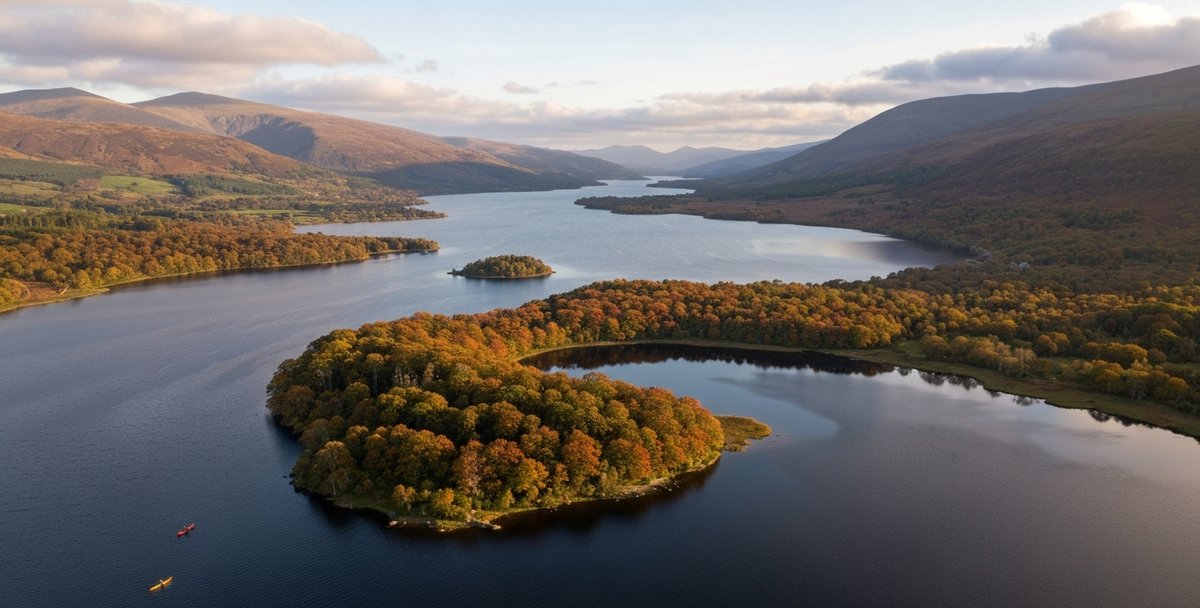
The Three Lakes of Killarney
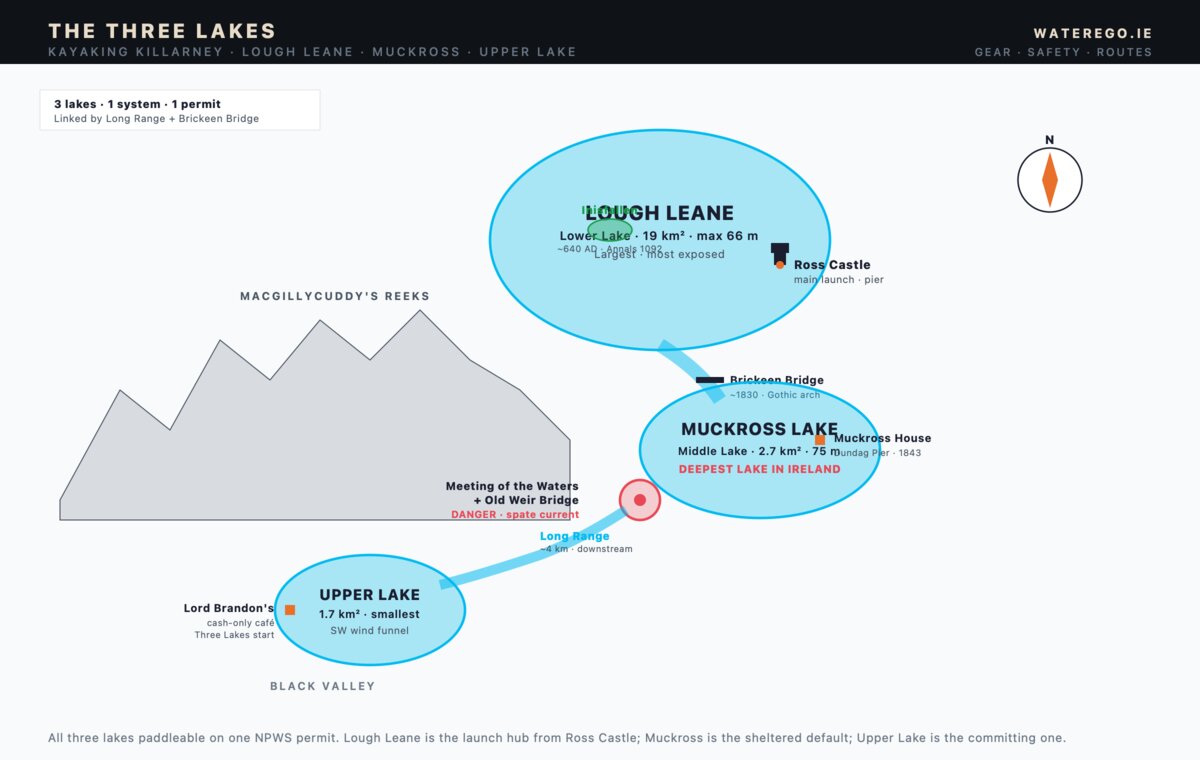
The Lakes of Killarney are three connected freshwater bodies sitting inside Killarney National Park in Co. Kerry. They are linked end to end by short channels — the Long Range river between the Upper Lake and Muckross Lake, and the narrow strait under Brickeen Bridge between Muckross Lake and Lough Leane. From a kayaker’s point of view they behave like one paddleable system, but each lake has a distinct character, depth, and wind profile.
Lough Leane — the Lower Lake
Lough Leane (Loch Léin, “lake of learning”) is the biggest of the three at roughly 19 km² and the northernmost. Maximum depth is around 66 metres. It is the lake you launch on from Ross Castle and the lake that contains Inisfallen Island. It is also the lake with the most exposure — a long open south-west to north-east fetch of more than 5 kilometres lets the prevailing Kerry wind build short, steep chop quickly. In a Force 4 from the west, the open crossing from Ross Castle out to Inisfallen becomes intermediate paddling. The east shore behind Ross Castle and the lee side of Innisfallen are the reliably sheltered zones.
Muckross Lake — the Middle Lake
Muckross Lake (sometimes called the Middle Lake or Torc Lake in older sources) is the smallest of the three by surface area at roughly 2.7 km² but holds the most dramatic statistic on the system — it is Ireland’s deepest lake at a maximum of approximately 75 metres, with the deep hole sitting close to the steep Torc Mountain shore. The lake is surrounded by mature woodland — the Reenadinna yew wood on the peninsula side and the oakwood under Torc on the south. That woodland makes Muckross the most sheltered of the three from prevailing south-westerlies and the default beginner lake for most short guided sessions from Ross Castle. The deep cold water at the Torc end means cold-water shock risk lingers later into summer than on the shallower margins of Lough Leane.
Upper Lake
Upper Lake is the smallest of the three at roughly 1.7 km² and the southernmost, sitting deeper into the valley with the Black Valley and the Gap of Dunloe at its head. It is more sheltered from true westerlies by the bulk of the Reeks ridge, but the valley orientation funnels a south-westerly wind directly along the lake’s long axis — exactly the wind angle that gives the lake its worst conditions. The Upper Lake is connected to Muckross Lake by the Long Range, a narrow ~4 kilometre channel of slow river with one set-piece feature at its downstream end — the Old Weir Bridge.
Naming convention used in this guide
Tourism sources use “Lower, Middle, Upper Lake” almost interchangeably with the Irish names. Ecological and scientific sources (NPWS, Inland Fisheries Ireland, EPA Lake Monitoring) consistently use Lough Leane, Muckross Lake, and Upper Lake — that is the convention this guide follows.
Meeting of the Waters and the Old Weir Bridge
The Meeting of the Waters is the basin where the Long Range river — draining the Upper Lake — pours into the eastern end of Muckross Lake, with Lough Leane joining the system through the separate Brickeen Bridge channel just a few hundred metres away. It is the single most-photographed kayak destination in Killarney and the single most genuinely dangerous moving-water feature on the lake system in spate conditions.
The Old Weir Bridge
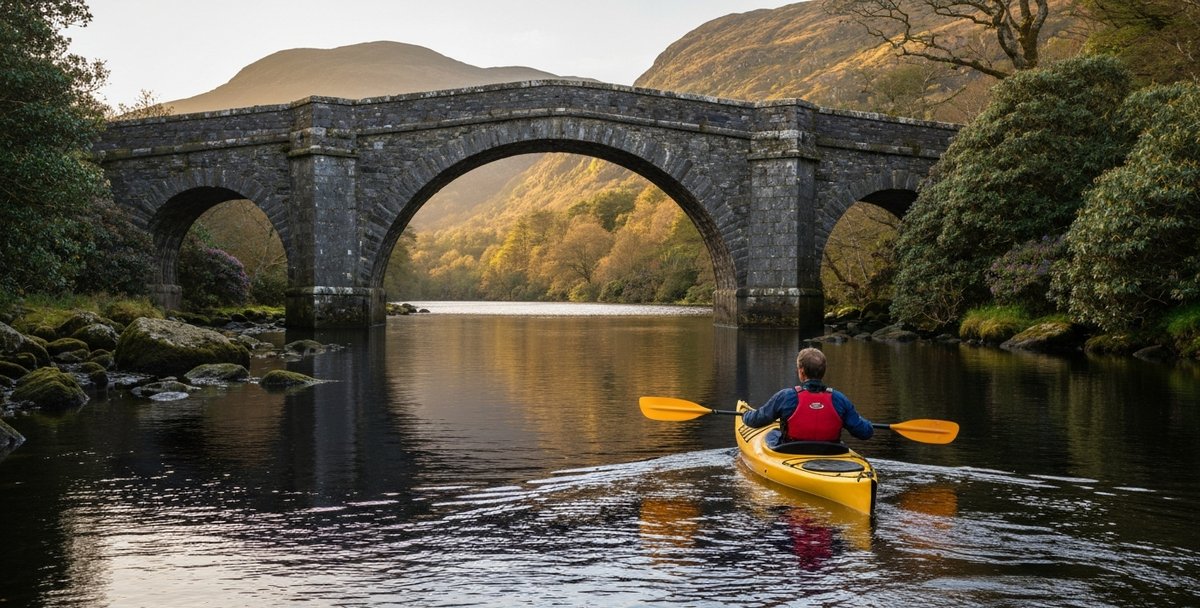
The Old Weir Bridge is a twin-arch stone span across the channel where the Long Range enters Muckross Lake. It is believed to date from the 16th century, restored under OPW care from October 2023 onwards, and survived the catastrophic September 1867 flood that washed away the original Dinis Cottage and other estate structures. A low weir sits directly below the arches, regulating flow out of the Upper Lake system. In low water the channel is too shallow to “shoot” and boats walk through. In high water it becomes a venturi — fast laminar flow at the arches, a recirculating eddy below known locally as O’Sullivan’s Punchbowl.
What the current actually does
Most tourist descriptions call the current at the Meeting of the Waters “reversing” or “tidal.” Neither is strictly accurate. The actual mechanism is simpler and more dangerous. After 24–48 hours of Kerry rainfall, the Upper Lake fills faster than it can drain through the narrow Long Range, and the volume of water pressing through the constricted bridge arches becomes a genuine downstream rapid. An 1840 description called it a “dangerous spot, and many accidents have occurred in shooting the rapid.” That description still holds. The historic curiosity that gives the place its mystique is that during certain spate conditions, Muckross Lake and Lough Leane can rise faster than the Upper Lake drains, briefly reversing the visible direction of flow at the meeting point — but this is a momentary local effect, not a tidal cycle.
How to read the bridge
The commercial Gap of Dunloe boatmen — running open dory-style boats between Lord Brandon’s Cottage and Ross Castle every day in season — read the bridge by eye. In low or moderate water they pole the boats through with passengers aboard. In high water they put passengers off on the south bank, walk them across the bridge on foot, then run the empty boats through and pick the passengers up in the calm water of Muckross Lake just downstream. That is the model for kayakers too: if you can see the water boiling at the arches or a clearly defined eddy on the downstream side, portage. If the channel looks like a placid river under the bridge, paddle through with care.
Dinis Cottage — the lunch stop
Dinis Cottage sits a few hundred metres back along the wooded path from the Old Weir Bridge — a Herbert family hunting lodge originally built in the 1700s, rebuilt around 1820 after falling into ruin, and operating as a tea-room for over 200 years. It closed for restoration in 2023 and reopened in 2024. Victorian glass etchings in the windows date from the 1820s. The cottage is the natural land-side terminus of the Meeting of the Waters and the standard lunch stop on the Three Lakes traverse.
Paddle approach times
There is no operator-published authoritative paddler distance for the Meeting of the Waters from any of the three standard launches. Best evidence-based estimates:
- Ross Castle to Old Weir Bridge (via Lough Leane, under Brickeen Bridge, across Muckross Lake) — approximately 6–7 kilometres one way, 1.5–2 hours steady paddling.
- Muckross House (Dundag Pier) to Old Weir Bridge — approximately 3–4 kilometres along the south shore of Muckross Lake, 45–75 minutes.
- Lord Brandon’s Cottage to Old Weir Bridge (downstream along the Long Range) — approximately 5–6 kilometres, downstream-assisted, 1–1.5 hours.
Permits and Access — The NPWS Canoe Permit System
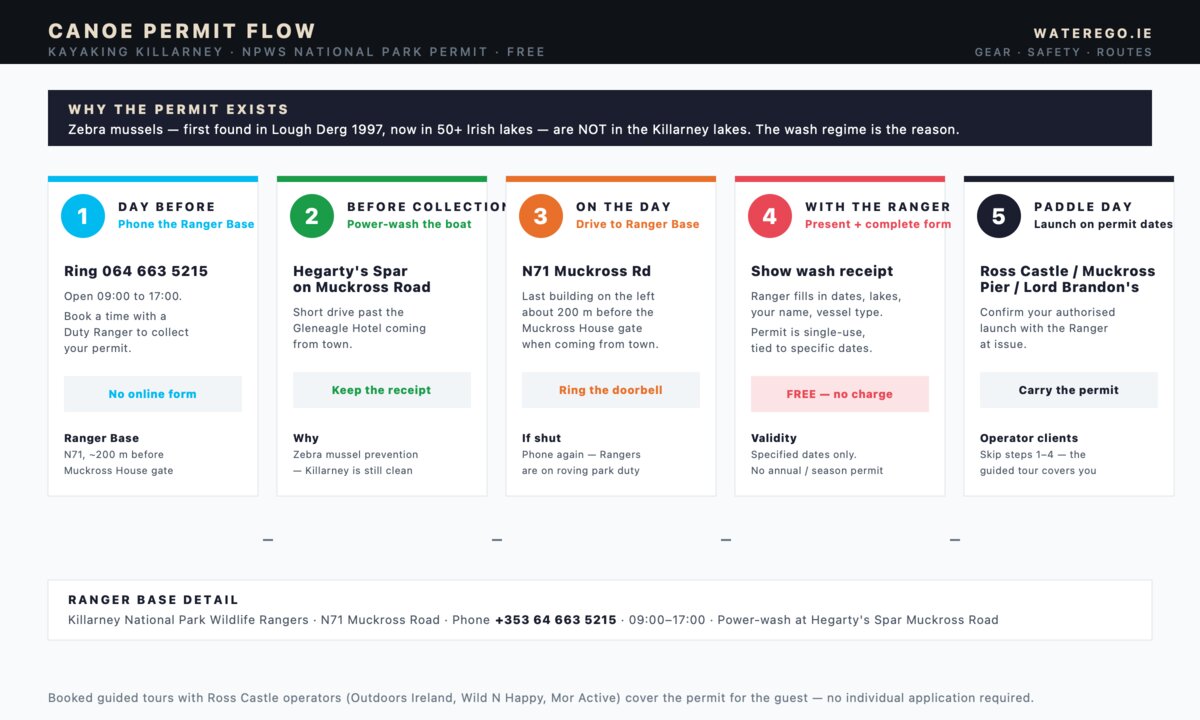
A canoe permit issued by the National Parks and Wildlife Service is mandatory for any private kayak or canoe on the Killarney Lakes. The permit itself is free of charge. The system exists to keep zebra mussels — established in Lough Derg since 1997 and now in 50+ Irish lakes — out of the Killarney system, which remains zebra-mussel-free as of mid-2025.
What the NPWS PDF says
The official permit guidance is a single-page PDF at nationalparks.ie. The key requirements:
- Who needs one. Anyone putting a private kayak or canoe on the water inside Killarney National Park. The PDF makes no distinction between solo paddlers, organised club groups, or commercial operator clients — though operators’ own arrangements typically cover their booked guests.
- How to get one. In person only, at the Killarney National Park Wildlife Rangers base on the N71, approximately 200 metres before the main entrance gate to Muckross House. Ring the doorbell at the front. There is no online form and no email application channel.
- Phone ahead. Call the Ranger Base on +353 64 663 5215 between 09:00 and 17:00, ideally the day before at the latest, to book a time with a Ranger.
- Cost. The permit is free. The only cost is the power-wash receipt.
- Validity. Single-use, valid only for the dates specified on the permit form by the issuing Ranger. There is no annual or season permit.
- The power-wash. Mandatory before issue. The PDF recommends Hegarty’s Spar on Muckross Road, a short distance beyond the Gleneagle Hotel coming from town. Keep the receipt — Rangers ask to see it before issuing the permit.
Where you launch from
The PDF does not name authorised slipways. In practice, the public launches are Ross Castle lower car park for Lough Leane, Muckross House pier for Muckross Lake, and Lord Brandon’s Cottage for the Upper Lake. The issuing Ranger will confirm the launch point that matches your planned route.
What the PDF does not say
Several questions paddlers ask are not addressed in the official document and need a phone call to the Ranger Base to confirm:
- Whether commercial operator licences cover their booked clients without each client needing an individual permit (in practice yes, but the document does not state this)
- Specific exclusion zones during white-tailed eagle nesting season
- Group-size caps for organised clubs
- Minor / under-18 paddler rules
- Insurance requirements
- Penalties for paddling without a permit
When in doubt, phone the Ranger Base. They answer questions politely and they do enforce permits — Rangers can and do turn paddlers around at the launch.
Operator clients
If you are booking a guided tour with one of the Ross Castle operators below, you do not need to apply for your own permit. The operator’s existing arrangements with NPWS cover the booked tour. This is the easiest way for visitors to paddle Killarney legally without a five-step preparation process.
Where to Launch
The Killarney Lakes have three useful kayak launches and one important take-out, plus several auxiliary spots used by operators and guides.
Ross Castle lower car park — the main launch
Ross Castle lower car park sits on Lough Leane, about 2.5 kilometres south-west of Killarney town. It is the de facto launch hub for the lake system — public, OPW-managed, free car parking (large), free coach parking, public toilets including an accessible toilet, slipway and pier shared with cruise boats, fishing boats, and kayakers, and a seasonal coffee shop from May to September. Every Ross Castle-based commercial operator meets clients here. It gets busy mid-day in summer; arrive before 10:00 if you are launching independently.
Muckross House (Dundag Pier)
Muckross House pier — specifically Dundag Pier, signposted about 400 metres from the house itself — is the natural launch for Muckross Lake. Paid parking at the Muckross House visitor car park, toilets, café, and the house and gardens at the put-in. Most independent paddlers planning a Muckross loop or an east-bound Old Weir Bridge trip launch here rather than fighting through Brickeen from Lough Leane.
Lord Brandon’s Cottage — the Three Lakes start
Lord Brandon’s Cottage is a small pier and seasonal tea-room at the head of the Upper Lake, accessed via the narrow Black Valley road from Moll’s Gap (about 45 minutes from Killarney town). It is the start of the classic Three Lakes traverse. Parking is very limited; most Gap of Dunloe visitors arrive on foot or pony-trap from Kate Kearney’s Cottage. There is a basic café, soup-and-sandwiches level, cash only. The cottage closes October to April.
Dinis Cottage
Dinis Cottage is not a vehicle-served launch — it is a waypoint and a foot-only access point for the Meeting of the Waters and the Old Weir Bridge. Reached by a 20–25 minute walk from a N71 layby, or 5 kilometres along the lakeshore Arthur Young’s Walk from Muckross House. Kayakers pass it; they do not launch from it.
Reen Pier
Reen Pier sits at the eastern end of Lough Leane, just east of Ross Castle. Less crowded than the castle slipway, used mainly by Pride of the Lakes cruise boats and a small number of paddlers. The east-shore lee here is one of the most reliably sheltered launch points on the lake in westerly conditions.
Six Best Routes
The six routes below cover every realistic Killarney kayak day, from a one-hour Innisfallen return as a first-paddle out to the full point-to-point Three Lakes traverse. Distances are evidence-based estimates — operators do not publish standardised paddler distances on these lakes.
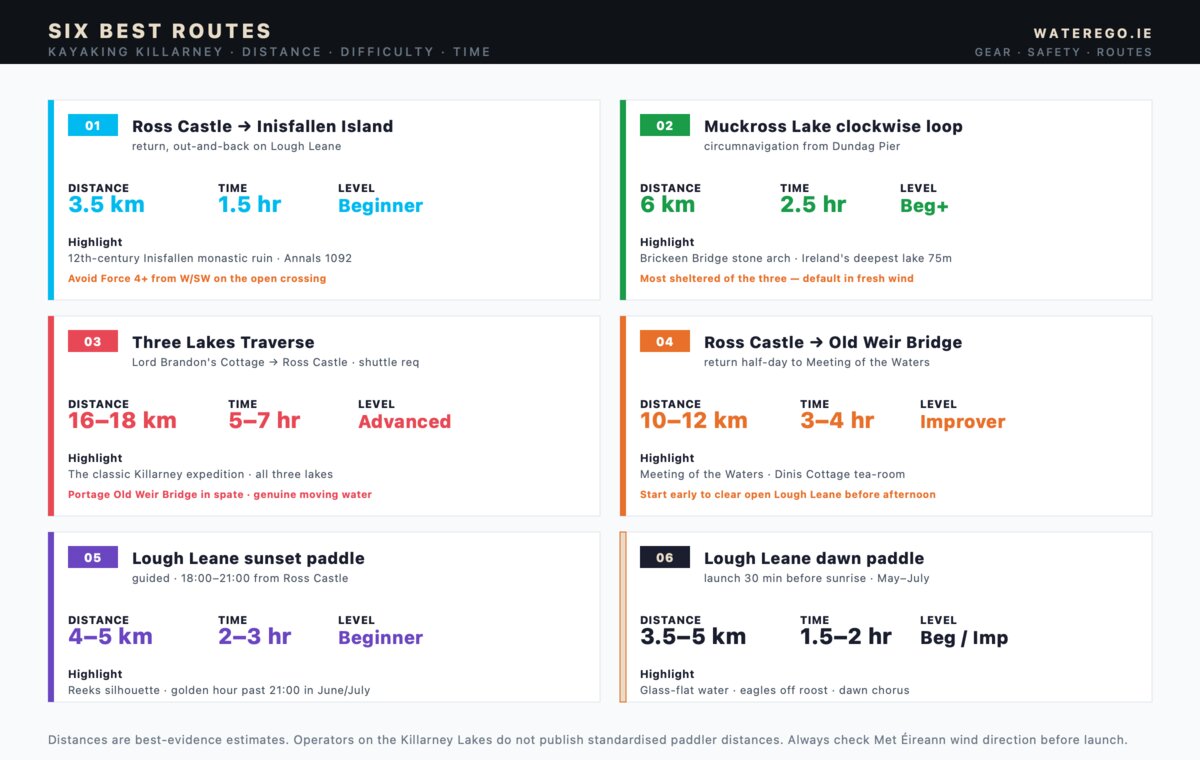
Route 1 — Ross Castle to Innisfallen Island and back
| Field | Detail |
|---|---|
| Distance | ~3.5 km return (island lies ~1.5 km off Ross Bay) |
| Time | 1 to 1.5 hours paddling; allow 2–2.5 hours with a landing |
| Difficulty | Beginner |
| Best season | May to September; mid-morning for calmest water |
| Wind caveat | Westerlies and south-westerlies kick up chop on the open crossing — avoid in Force 4+ from the W/SW |
| Logistics | Ross Castle car park; no shuttle |
The classic one-hour beginner paddle. Launch at Ross Castle, paddle a short shelter-line along Ross Island, then cross to Inisfallen — 1.5 kilometres of open water — land on the small east-side beach, walk the monastic ruin, return the same way. White-tailed eagles regularly hunt over Lough Leane and the broader park; you may spot them overhead during the crossing. Landing on Inisfallen is permitted but informal — treat the 12th-century stonework as the heritage site it is and never climb the ruins.
Route 2 — Muckross Lake clockwise loop
| Field | Detail |
|---|---|
| Distance | ~6 km circumnavigation |
| Time | 2 to 2.5 hours at a relaxed pace |
| Difficulty | Beginner / Improver |
| Best season | April to October; spring rhododendron flowers late May |
| Wind caveat | More sheltered than Lough Leane, but easterlies channel along the long axis |
| Logistics | Muckross House car park; no shuttle |
Muckross is the default beginner-confidence-builder. Launch at Dundag Pier and paddle clockwise — keeping the shore to your left — past the Colleen Bawn Rock and the limestone cliffs on the south shore under Torc Mountain. The set-piece is Brickeen Bridge in the western corner — a single-arched stone span built around 1830 as part of the Herbert estate landscape, connecting Brickeen Island to the Muckross Peninsula, separating Lough Leane from Muckross Lake. Paddle directly under the arch — a tight, atmospheric passage between the two lakes, then continue the loop back to Dundag. The deep cold water at the Torc end (the 75-metre hole) means full wetsuit cover is sensible even in July.
Route 3 — Three Lakes Traverse (Lord Brandon’s to Ross Castle)
| Field | Detail |
|---|---|
| Distance | ~16–18 km point-to-point |
| Time | 5 to 7 hours including portage and lunch |
| Difficulty | Advanced — committing, moving water at the Old Weir Bridge, exposed crossings |
| Best season | Mid-May to mid-September only |
| Wind caveat | Westerlies on Lough Leane will be in your face on the final 4–5 km to Ross Castle |
| Logistics | Requires a shuttle |
The classic Killarney expedition day. Launch at Lord Brandon’s Cottage in the Black Valley, paddle the full length of the Upper Lake, descend the Long Range river downstream-assisted, portage or carefully run the Old Weir Bridge depending on water level, rest at Dinis Cottage, paddle the length of Muckross Lake, pass under Brickeen Bridge into Lough Leane, and finish at Ross Castle with the open crossing past Innisfallen. A genuine commitment paddle — not for first-timers and not for any group without a check on the day’s water level at the bridge. Either pre-position a vehicle at Ross Castle and drive a second to Lord Brandon’s via Moll’s Gap, or pre-book a shuttle with a local outfitter. Allow 45 minutes for the Lord Brandon’s drive — the Black Valley road is single-track and slow. Lord Brandon’s Cottage tea-room (cash only, seasonal) is at the put-in; Dinis Cottage is the only en-route facility.
No operator currently sells the full Lord Brandon’s to Ross Castle traverse as a named, publicly priced one-way product with shuttle. Outdoors Ireland’s full-day product at €120 covers two of the three lakes and is the closest equivalent — a true traverse with shuttle is enquiry-only.
Route 4 — Ross Castle to the Old Weir Bridge return
| Field | Detail |
|---|---|
| Distance | ~10–12 km return |
| Time | 3 to 4 hours half-day |
| Difficulty | Improver — flat water with one moving-water feature |
| Best season | June to September |
| Wind caveat | Start early to clear the open Lough Leane crossing before afternoon wind |
| Logistics | Ross Castle car park; no shuttle |
The half-day Meeting of the Waters trip without committing to the full traverse. Launch at Ross Castle, paddle east across Lough Leane, pass under Brickeen Bridge into Muckross Lake, continue east along the south shore to the Old Weir Bridge and the Meeting of the Waters basin. Rest at Dinis Cottage if open. Return the same way. Do not attempt to paddle under the Old Weir Bridge in high water — get out on the south bank and walk around. Bring a dry-bag for valuables in case you need to portage.
Route 5 — Lough Leane sunset paddle
| Field | Detail |
|---|---|
| Distance | ~4–5 km |
| Time | 2 to 3 hours (typical 18:00–21:00 start) |
| Difficulty | Beginner — guided |
| Best season | June and July when sunset is 21:50–22:10 |
| Wind caveat | Evenings typically calm; watch katabatic flow off the Reeks late |
| Logistics | Ross Castle; book direct with operator |
The most popular guided product on the lakes. Mirror-flat water under low golden light, the Reeks silhouetted to the west, Innisfallen Island in the foreground. Pine martens and red deer occasionally drink on the Ross Island shore at dusk. Operators include Killarney Kayaking (the Outdoors Ireland trading name at Ross Castle) and other Ross Castle-based providers. Booking is essential; permits, biosecurity, and all safety equipment are handled by the operator. Trips cancel in Force 4+.
Route 6 — Lough Leane dawn paddle
| Field | Detail |
|---|---|
| Distance | ~3.5–5 km |
| Time | 1.5 to 2 hours; launch ~30 min before sunrise |
| Difficulty | Beginner if guided / Improver if independent |
| Best season | Late May through July (sunrise ~05:15–05:40) |
| Wind caveat | Statistically calmest part of the day; watch lake mist |
| Logistics | Ross Castle; permit collected previous day if independent |
The quieter, mirror-flat alternative to the sunset paddle. Dawn is statistically the calmest part of the 24-hour cycle on Lough Leane and the most likely window for white-tailed eagles leaving roost. The catch is mist — atmospheric but disorienting. Carry a compass or GPS and a whistle. Independent paddlers need to have collected their NPWS permit the previous day. Few operators run scheduled dawn tours; arrange on request.
Operators and Tour Pricing 2026
Every commercial kayak offering on the Killarney Lakes in 2026 is guided. There is no self-paddle hire on the lakes themselves — every operator surveyed runs instructor-led group tours from Ross Castle, with kayak, paddle, buoyancy aid, and wetsuit included. Private paddling without an operator is allowed but requires the NPWS permit and a power-washed boat. The five active operators are:
Outdoors Ireland (trading as Killarney Kayaking)
Ross Castle lower car park. Half-day morning or afternoon tour €60 (3 hours), sunset tour €70 (3 hours, 18:00–21:00), full-day tour €120 (6 hours). No self-paddle hire. Email and phone booking — they do not run online checkout. Beginners welcome. Reported to be the only operator licensed to run on the lakes after 18:00 (verify before relying on this). Email killarneykayakingtours@gmail.com, phone +353 87 780 2115. outdoorsireland.com / killarneykayaking.com
Wild N Happy Travel
Ross Castle lower car park (meet at the dark blue van). Ross Castle 2-hour tour from €40, Innisfallen Island 2.5-hour tour from €50, 2-day Discover Killarney package from €130. Online booking through their own website and via Viator/GetYourGuide. Beginners welcome. Maximum 14 per group. Phone +353 86 389 0171. wildnhappytravel.com
Mor Active Tours
Ross Castle lower car park. Killarney Kayaking Tour to Innisfallen Island at €50 per adult, private group rate €350 (up to 7) or €700 (up to 14). 2.5-hour duration. Online and phone booking. Beginners welcome. Maximum 14 per outing. moractivetours.com
Irish Adventures (Dingle-based)
Operates Killarney trips on request from their Dingle base. Pricing for the Killarney product is not listed publicly — phone or email enquiry only. Family-friendly. Phone +353 87 419 0318. irishadventures.ie
Cappanalea OETC (Caragh Lake, ~30 km west)
State-funded outdoor education centre on Caragh Lake. Offers half-day and full-day kayak and canoe courses. Will run sessions on the Killarney Lakes “by prior agreement.” Course-based, not hourly hire. Pricing on quote. Phone +353 66 976 9244. cappanalea.ie
What is included in a guided tour
Standardised across the Ross Castle operators (Outdoors Ireland, Wild N Happy, Mor Active):
- Double sit-on-top kayak (the standard boat type on the lakes)
- Paddle
- Buoyancy aid
- Wetsuit
- Qualified instructor with the group
- Safety briefing and basic stroke tuition before launch
- Maximum group size around 14 per outing per guide group
- Photography by the guide (called out specifically by Outdoors Ireland)
Bring yourself: swimwear to layer under the wetsuit, a non-cotton top and light jacket for over the wetsuit, trainers that can get wet, towel and dry clothes for after, around 500 ml of drinking water. No cotton in any layer — it holds water and chills.
What is not on offer
- Self-paddle kayak hire on the Killarney Lakes — every operator is guided
- Standardised one-way Three Lakes traverse with shuttle as a named product — enquiry-only at best
- Winter kayak tours — the standard commercial season runs March or April to October only
Safety on the Killarney Lakes
Killarney is enclosed lake paddling, not coastal — but the lakes have specific risks that catch out unprepared first-timers.
Wind by lake
The prevailing Kerry wind blows from the south-west through west. Lough Leane has the longest open fetch and feels the wind most. The conventional kayaking ceiling for beginners on open water is Force 3 (gentle breeze, ~7–10 knots / 13–19 km/h). Force 4 (~11–16 knots) sees whitecaps form and is where things get sporty — a stationary kayak can be blown sideways at 1–1.5 knots and beginners struggle to hold a line.
- Lough Leane — beginners aim for Force 3 or less. Force 4 from W/SW means staying in the east-shore lee behind Ross Castle and Reen Pier. Avoid open crossings to Glena or O’Sullivan’s Cascade. Force 5+ is no-paddle for beginners.
- Muckross Lake — most sheltered of the three thanks to surrounding woodland. The default beginner lake on poor days.
- Upper Lake — sheltered from true westerlies by the Reeks but the valley funnels a south-westerly directly along the long axis. Check the wind direction, not just the speed.
The Old Weir Bridge — the one genuine danger
Covered in detail above. In low or moderate water, the channel under the bridge is paddleable with care. After sustained Kerry rainfall, it becomes a hydraulic hazard — fast laminar flow at the arches, O’Sullivan’s Punchbowl eddy below. Portage on the south (Dinis) bank in any doubt. Do not commit to running the bridge unless you have whitewater training and have inspected the flow.
Cold water by month
Cold-water shock risk persists below 15 °C. Lake surface temperatures on Lough Leane and Muckross run roughly:
- April: 8–10 °C — full cold-water shock risk
- May: 11–13 °C — still in the danger band
- June: 14–16 °C — borderline at depth
- July: 16–18 °C — above shock threshold at surface
- August: 17–18 °C (warmest)
- September: 15–17 °C
- October: 12–14 °C — back into the danger band
Muckross stays measurably colder year-round than the shallows of Lough Leane because of the 75-metre cold pool.
Boat traffic and right of way
The MV Pride of the Lakes runs scheduled sailings from Ross Castle through the May–September season — typically 11:00, 12:30, 14:30, 16:00. Open water-coaches with outboards run Ross Castle to Lord Brandon’s Cottage via Brickeen, Muckross, the Long Range, and the Old Weir Bridge as part of the daily Gap of Dunloe trip. A kayak is technically a “vessel under oars” under the Collision Regulations and is the give-way vessel against power-driven craft in a narrow channel. Practically: assume the tour boats have not seen you. Cross their tracks at right angles, stay clear of the Reen Pier and Ross Castle approach corridors, and never sit in the throat under Brickeen Bridge or in the Old Weir Bridge channel while a water-coach is approaching.
Phone signal
Killarney town and the east shore of Lough Leane have reliable 4G/5G on all three Irish networks. The west shore (Glena, O’Sullivan’s Cascade) and the entire Long Range and Upper Lake are patchy — the valley walls block line-of-sight to the masts. Vodafone is generally regarded as the most reliable carrier in the southern Kerry uplands but expect dead zones. Plan as if you have no signal on the Upper Lake and leave a written float plan with a non-paddler ashore.
Tell someone your plan
Minimum information to leave with a non-paddler:
- Launch point and intended turning point
- Number in party, vessel descriptions
- Expected off-water time and a hard “raise the alarm” time
- Phone number, network, and the fact you may have no signal
- Emergency contact: 999 or 112 — ask for Coast Guard, who coordinate inland water rescue with Kerry Mountain Rescue and Killarney Fire Service
Wildlife and Heritage You Paddle Past
The Killarney Lakes sit inside a Special Protection Area under the EU Birds Directive and a Special Area of Conservation. 141 bird species have been recorded in the park. The wildlife and heritage you paddle past are the reason this is the most-photographed kayak destination in Ireland.
White-tailed eagle
The white-tailed eagle reintroduction to Killarney National Park began in 2007, led by NPWS in partnership with the Golden Eagle Trust and the Norwegian Institute for Nature Research. The original phase released 100 chicks from Norway between 2007 and 2011. A second phase ran 2020–2022. NPWS reported approximately 245 chicks released by 2025, when the formal release phase completed. The Killarney population is now self-sustaining, with successful breeding in the park for multiple consecutive years.
Eagles are visible year-round; March to August is the breeding-to-fledging window. Nest sites are protected — it is an offence under the Wildlife Acts to wilfully disturb a nest. NPWS does not publicise current nest locations. Standing advice: if a bird circles or vocalises at you, you are too close — back off at least a couple of hundred metres. Never linger near known nest cliffs or wooded islands, particularly March to May.
Native red deer
The Killarney herd is the only surviving native red deer population in mainland Ireland — continuously present since approximately Neolithic times, around 4,000 years. Population estimate is roughly 700 to 900 individuals (NPWS, 2017 estimates). Fully legally protected — no hunting permitted. Most reliably visible along the lower wooded slopes around the Upper Lake, the Long Range, and the southern shores of Muckross Lake. The deer you see on Inisfallen Island are sika, not red — introduced in the 19th century and a hybridisation risk to the native red deer.
Killarney shad (goureen)
The Killarney shad — Alosa killarnensis, the goureen — is endemic to Lough Leane and nowhere else on earth. A landlocked subspecies of the twaite shad, trapped in Lough Leane after the last glaciation. The Irish national assessment treats the species as Critically Endangered given its single-lake range. Threats: eutrophication, water quality decline, and invasive fish species (roach, rudd, bream).
Arctic char
Present historically in all three lakes as a glacial relict. The Upper Lake population is regarded as likely extirpated. Muckross Lake — deep and cold — retains the strongest remaining population.
Brown trout and salmon
Brown trout fishing is free on the Killarney lakes — one of the few free-fishery wild brown trout systems in Ireland. No permit required. Salmon and sea trout require a state salmon licence from Inland Fisheries Ireland (annual ~€100, daily ~€36) and a fishery permit for the specific water. The canoe permit is separate from any fishing permit.
Other birds
Peregrine falcon nests in the park’s upland cliffs. Kingfisher and dipper on the streams. Grey heron, mute swan, little grebe on the lake edges. Wintering specialities on Lough Leane include whooper swan, wigeon, teal, goldeneye, and golden plover. Red kite, contrary to some tourist literature, was not reintroduced to Killarney — sightings in Kerry are occasional dispersers from the Wicklow, Down, or Fingal reintroduction populations.
Inisfallen Island
Monastic settlement founded around 640 AD, traditionally attributed to St Finian. The Augustinian Priory of St Mary post-dates the late 12th-century Norman invasion. The famous Annals of Inisfallen were compiled here around 1092 — a Munster-focused chronicle of Irish history from 433 to 1450, continued by later hands; manuscript now held by the Bodleian Library, Oxford. The 1180 raid by the O’Donoghue clan is recorded in the Annals themselves. Stone ruins date mainly from the 10th to 12th centuries. Landing is permitted on the small east-side beach. Treat the ruins as the OPW heritage site they are.
Ross Castle
Tower-house keep built in the late 15th century by the O’Donoghue Mór clan. Captured in 1652 by General Ludlow’s Cromwellian forces — reportedly the last Munster stronghold to fall, partly due to a prophecy that it would only fall when attacked from the water. Served as a military barracks through the 18th and 19th centuries. OPW restoration completed and the castle opened to the public in 1993. The main public launch for the lakes is the pier directly below the castle.
Muckross House
Tudor-revival manor by Scottish architect William Burn, built 1839–1843 for Henry Arthur Herbert and Mary Balfour Herbert. 65 rooms. Queen Victoria visited in 1861 — the expensive preparations contributed to the Herberts’ eventual financial collapse. The estate was eventually owned by Arthur Bourn Vincent, who gifted house and estate to the Irish nation in 1932 as the Bourn-Vincent Memorial Park — the founding core of what became Killarney National Park.
Brickeen Bridge
Single pointed-Gothic stone arch connecting Brickeen Island to the Muckross Peninsula, separating Lough Leane from Muckross Lake. Construction date contested — most sources give early 19th century, around 1830, as part of the Herbert estate designed landscape. Kayakers paddle directly under the arch — a tight, atmospheric passage between the two lakes.
Biosecurity — why your boat must be power-washed
Zebra mussel (Dreissena polymorpha) was first recorded in Ireland in Lough Derg in 1997 and is now in more than 50 Irish lakes. The Killarney lakes remain zebra-mussel-free as of mid-2025 and the NPWS canoe permit power-wash requirement is explicitly the control mechanism. The same applies to your trolley wheels, strap, drybag, and footwear. Three-step Check Clean Dry standard from Canoeing Ireland and the National Biodiversity Data Centre: CHECK boat, paddle, footwear, drysuit for mud and plant fragments after every outing; CLEAN with hot water above 45 °C or high-pressure spray; DRY for at least 48 hours before next use.
Best Time to Paddle Killarney
The recreational season is April to October. Commercial guided operators run May to September as their core trading window. Winter paddling on the lakes is done by experienced clubs only — high water levels make the Meeting of the Waters genuinely dangerous and the cold-water risk is total immersion within minutes.
Best months by purpose
- Best weather window: typically May, June, and September. September is the driest month of the year at roughly 93 mm. May has the most sunshine hours at around 6 hours per day.
- Wettest month: December at around 128 mm. The full year totals around 1,283 mm.
- Comparison to Dublin: Killarney’s 1,283 mm is roughly 1.7× Dublin Airport’s long-term mean of about 758 mm.
- July and August: despite being summer, both can deliver 100+ mm of rain and frontal passages. A July plan is not a guaranteed paddle.
Sunset and dawn
- Longest day is 21 June. Earliest sunrise in late June is around 05:18; latest sunset around 22:03.
- Best sunset paddling months are June and July, when golden hour stretches past 21:00 and the lake often glasses off as wind drops.
- Best dawn paddle window is May through July, with sunrise between 05:15 and 05:45. Fog on Lough Leane typically lifts within 1–2 hours of sunrise as the air warms.
White-tailed eagle viewing
Year-round resident since the 2007–2012 reintroduction. Breeding and nesting is March through May. Best general viewing is March through August — spring nesting activity around territory, then summer juveniles hunting fish over the lakes.
What to Wear and Bring
Kit list for enclosed-lake paddling on Killarney. Not the same as sea-kayak gear.
Mandatory
- PFD worn, not stowed. Properly sized so it does not ride up over your ears when you fall in.
- Whistle on the PFD. One blast for attention, three for help. Pea-less marine whistles work wet.
Body — by month
- April / October (water <12 °C): full 3/2 mm or 4/3 mm wetsuit, neoprene boots, optional gloves and skull-cap.
- May / early June / September (water 12–16 °C): full 3/2 mm wetsuit. Experienced paddlers might run a shorty plus thermal top.
- High summer (mid-June to August, water 16–18 °C): 3 mm shorty is adequate for a planned 1–2 hour session in sheltered water close to shore. Carry a thermal in the dry bag if heading toward Upper Lake.
A wetsuit is not optional outside the high-summer window. Commercial operators provide them with every booking.
Footwear
Old runners, neoprene wetsuit boots, or sandals with heel strap. You will get wet at Ross Castle’s stony slipway. Avoid flip-flops — they come off in the silt at the Lord Brandon’s Cottage end.
Carry on the boat
- Dry-bag (5–10 L) for spare clothes, phone, snacks
- Phone in a dedicated waterproof case with lanyard — assume no signal on the Upper Lake
- 500 ml drinking water minimum, plus a snack
- Sun protection: SPF 30+ (cloud does not block UV reflection off water), peaked cap, sunglasses on retainer
- Midge repellent — Smidge or 30%+ DEET. Killarney midge season is late May through August, peak biting mid-June to mid-August. Worst at dawn and dusk in calm humid conditions — exactly the sunset paddle window.
- Small first-aid kit in a dry bag: plasters, blister kit, paracetamol, anti-histamine
Add for the Three Lakes traverse only
- Compass and a paper map (OSI 1:50,000 Sheet 78 or Killarney National Park map)
- Throw line (15–20 m)
- Spare paddle or paddle leash
- Head-torch in case the day stretches
Do not bring
This is enclosed lake paddling, not sea kayaking. You do not need a deck compass, paddle float, stirrup, or marine flares. Whistle and phone are the correct signal.
Common Beginner Mistakes on the Killarney Lakes
Real environment-specific mistakes, drawn from operator advisories and NPWS guidance.
- Underestimating Lough Leane wind on a sunny day. Kerry sun comes with W/SW airflow off the Atlantic — the lake can be calm at the Ross Castle slip and Force 4 with whitecaps a kilometre out past Innisfallen.
- Attempting the Three Lakes traverse without checking water levels at the Old Weir Bridge. After 24–48 hours of Kerry rain the bridge channel is no longer a beginner feature.
- Paddling the Muckross loop without checking wind direction. Set off downwind in a fresh breeze and you will be paddling upwind home, tired, in colder water than you started in.
- Approaching Inisfallen too close during eagle nesting season — March through May. Wildlife Acts apply.
- Skipping the NPWS canoe permit and being turned around by a Ranger at the slipway. The permit is free; the inconvenience is total.
- Ignoring the Killarney rainfall forecast. A 30-minute squall can drop air temperature 5–8 °C. Without a waterproof shell in the dry bag, beginners chill fast.
- Bringing the dog without thinking about midges. Calm humid evenings are peak midge density and dogs sitting still on a sit-on-top get bitten worse than the paddler.
- Paddling solo on the Upper Lake without phone signal and without leaving a written float plan with a non-paddler.
- Launching from Reen Pier across the Pride of the Lakes departure track. The water-bus has a fixed schedule and beginners drifting sideways across the harbour mouth in a SW breeze are a known headache.
- Trusting forum chat that “Force 4 is fine.” Force 4 on a 19 km² fetch like Lough Leane is fine for an instructed group in 3/2 mm wetsuits hugging the lee shore. It is not fine for a first-time paddler 800 metres off the Glena shore.
Frequently Asked Questions
Do I need a permit to kayak in Killarney?
Yes, if you bring your own boat. Private kayaks and canoes require a free NPWS canoe permit issued in person at the Killarney National Park Wildlife Rangers base on the N71, approximately 200 metres before the Muckross House entrance. The boat must be power-washed first (receipt required). Phone +353 64 663 5215 between 09:00 and 17:00, ideally the day before, to book a Ranger appointment. Booked guided tours with the Ross Castle operators do not require a per-client permit — the operator’s arrangements cover their booked guests.
Where do you launch a kayak in Killarney?
The three main launches are Ross Castle (Lower Lake / Lough Leane), Muckross House Dundag Pier (Middle Lake / Muckross), and Lord Brandon’s Cottage (Upper Lake). Reen Pier is a quieter east-shore alternative on Lough Leane. Ross Castle is the de facto hub — free parking, public toilets, slipway, used by every commercial operator.
Is there kayak hire in Killarney?
No. Every commercial offering on the Killarney Lakes in 2026 is guided — there is no self-paddle hire on the lakes themselves. Visitors who want to paddle without committing to a guided tour need to bring their own boat, power-wash it, and obtain an NPWS permit. Guided tours from Outdoors Ireland, Wild N Happy, and Mor Active include the kayak, paddle, buoyancy aid, wetsuit, and instructor.
How much does kayaking in Killarney cost?
Standard 2-hour guided lake tours sit at €40–50. Half-day (3-hour) tours are €60. Sunset tours are €70. Full-day tours are €120. Private group rates start at €350 (up to 7) with Mor Active. Family rates are not published as a discounted line — Mor Active’s private rate is the de facto family booking.
How many lakes are in Killarney?
Three connected freshwater lakes — Lough Leane (the Lower Lake, ~19 km², largest), Muckross Lake (the Middle Lake, ~2.7 km², deepest at 75 m), and the Upper Lake (~1.7 km², smallest, southernmost). They are linked by the Long Range river (Upper to Muckross) and the Brickeen Bridge channel (Muckross to Lough Leane).
What is the deepest lake in Ireland?
Muckross Lake in Killarney is the deepest lake in Ireland at approximately 75 metres. The deep hole sits close to the steep Torc Mountain shore.
Can you kayak to Inisfallen Island?
Yes — Ross Castle to Inisfallen Island is the standard one-hour beginner paddle on Lough Leane, around 3.5 kilometres return. Landing is permitted on the small east-side beach. The 12th-century monastic ruin is a heritage site — do not climb the ruins.
Is the Three Lakes Traverse hard?
Yes — it is the most committing kayak day on the Killarney system. 16–18 kilometres, 5–7 hours, point-to-point from Lord Brandon’s Cottage to Ross Castle, with moving water at the Old Weir Bridge and exposed Lough Leane crossings on the final stretch. Not for first-timers and not for any group without checking water levels at the bridge on the morning. Requires a shuttle.
When is the best time to kayak Killarney?
May, June, and September are the best months — driest weather (September at ~93 mm), warm enough water, the longest sunset window in June and July. July and August can still deliver 100+ mm of rain and frontal passages. Winter paddling is for experienced clubs only — high water makes the Meeting of the Waters dangerous and cold-water shock risk is total.
What wildlife will I see kayaking in Killarney?
White-tailed eagles overhead (self-sustaining population since the 2007 reintroduction), the only surviving native red deer herd in mainland Ireland on the wooded shores, grey heron and kingfisher on the lake edges, occasional otters, and — for fish — wild brown trout (fishing free), Atlantic salmon, and the endemic Killarney shad found in Lough Leane and nowhere else on earth.
Final Word — Which Killarney Route Should You Pick?
If you have never paddled before, book a guided 2-hour tour at Ross Castle. €40–50 covers the boat, paddle, buoyancy aid, wetsuit, an instructor with you, and a route to Inisfallen Island or along the Ross Island shore. No permit hassle, no power-wash trip, no decisions about wind direction or water levels.
If you have paddled before and want a half-day on your own boat, get the NPWS permit the day before and run the Ross Castle to Old Weir Bridge return as Route 4 above. Ten to twelve kilometres, a single moving-water feature you can portage around if you do not like the look of it, and the Meeting of the Waters as the turnaround.
If you want a sunset trip with photographs, book the Outdoors Ireland sunset tour at €70 in June or July. Mirror-flat water, the Reeks silhouetted to the west, golden hour past 21:00.
If you are an experienced paddler with a full day and a shuttle vehicle, the Three Lakes Traverse from Lord Brandon’s Cottage to Ross Castle is the best lake paddle in Ireland — but check the water level at the Old Weir Bridge on the morning and be willing to portage.
The Killarney Lakes are an Irish kayaker’s destination paddle. Get the permit. Pick your day. Bring the midge repellent.
Also Read
- Kayaking for Beginners Ireland — the prerequisite guide if you have never paddled before. Read this before your first Killarney trip.
- Blueways Ireland — Every Paddling Trail Mapped — the eight designated flat-water trails. Killarney is not a blueway but the safety and gear advice transfers directly.
- Kayak Rental Ireland — 54 Verified Operators — every rental yard on the island. Killarney is the rare exception with no self-paddle hire — this directory covers everywhere else.
- Kayaking Clubs in Ireland — most clubs run trip weekends to Killarney. Cork-based Iorras Kayak Club and Killorglin Canoe Club are the closest.
- Sea Kayaking Ireland — full discipline guide. Lake paddling on Killarney is a different beast, but the wind, cold-water, and rescue principles transfer.
- Kayaking West Cork — the sea-paddling counterpart on the same Wild Atlantic coast.
- Kayak Trolley Ireland — the trolley is your friend at Ross Castle’s stony slipway and the Lord Brandon’s grass shore.

No comments yet on this route.
Be the first to share your experience — conditions, access, hazards, or anything a future paddler should know.
Login to join the discussion